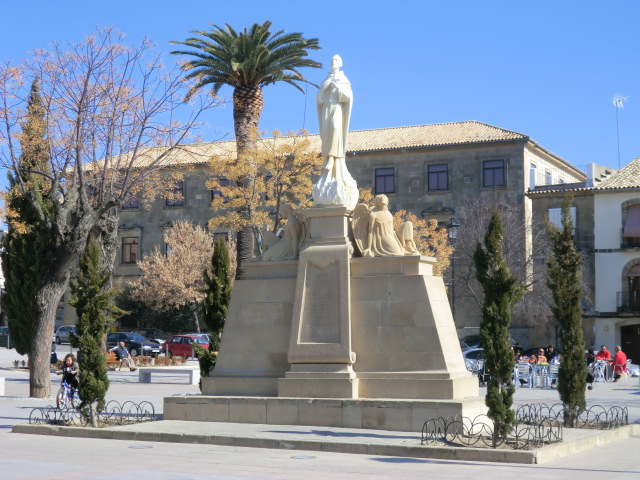
On the night of 13 December 1591, in a small Carmelite cell in Úbeda, a dying friar told the brothers reciting Matins around him, "Today I am going to sing the Office in Heaven." Before dawn he was dead. He had arrived at the monastery of San Miguel eleven weeks earlier, wasted by fever and, sources agree, by the hostility of a prior who made his final months hard. He was Juan de Yepes — known to history as St. John of the Cross, reformer of the Carmelite order and, after Teresa of Ávila, its second great mystic.
Construction began on the cell itself in 1627: a single-naved oratory raised directly over the room, sources agree the first church anywhere in the world built in his honor. Two years after his death, though, his body had already been exhumed in secret and moved north — a removal serious enough that a pope himself later intervened. Segovia would keep the larger portion of his remains; Úbeda, the room where he died.
Úbeda's old quarter — a dense weave of Renaissance palaces raised largely by the architect Andrés de Vandelvira — was inscribed by UNESCO in 2003 together with neighboring Baeza, recognition of civic and noble architecture rather than any religious claim. It means a pilgrim walking to the oratory crosses one of Spain's best-preserved Renaissance townscapes to get there.
📜 History & Spiritual Significance
Juan de Yepes was born on 24 June 1542 in Fontiveros, in the Castilian province of Ávila, into a family left in poverty after his father's early death. He entered the Carmelite order in 1563 and was ordained a priest in 1567 — the same year he met Teresa of Ávila, then in the midst of her own reform of the order toward a stricter, more contemplative observance. She persuaded him to join her cause, and in 1568 he became the first friar of what would grow into the Discalced Carmelites.
The reform provoked fierce resistance from Carmelites who had not accepted it. In 1577, friars opposed to the movement seized John and imprisoned him in a windowless cell in their Toledo monastery, where for nine months he was beaten, fed on scraps, and made to wear the penitential habit of the reform he had defied. In that cell, or in the months after he escaped through a window in August 1578, he composed the Spiritual Canticle and began the Dark Night of the Soul — the poem and treatise that would make him, alongside Teresa, one of the two founding voices of Spanish mystical literature.
He spent his last years governing Carmelite houses across Andalusia, work made harder by continuing opposition within the order, including from a fellow friar, Diego Evangelista. Ill with a fever and a leg ailment, he arrived at the Carmelite monastery of San Miguel in Úbeda on 28 August 1591 for treatment; the prior there gave him a poor welcome and a small, bare cell. He died in it on 14 December 1591, aged 49.
His body did not stay in Úbeda long. In 1593 the Segovia Carmelite community had it exhumed in secret and carried north — Úbeda had already kept one leg, and an arm was reportedly left as a relic in Madrid along the way. Úbeda's community protested the removal, and in October 1596 Pope Clement VIII issued a Brief ordering the body's return. What followed was not full compliance but a compromise among the order's own superiors: Segovia kept the head and torso, and Úbeda received a further leg and arm, with a finger and a tibia reportedly recovered later, in 1607. John was canonized in 1726 and declared a Doctor of the Church — the "Mystical Doctor" — by Pope Pius XI in 1926.
☩ Pilgrimage Sites in Úbeda
Oratory of St. John of the Cross
Oratorio de San Juan de la Cruz
Construction began in 1627 on the site of the cell where John died; sources describe it consistently as the first church built anywhere in the world in his honor. The single nave rises to an octagonal apse, and the high choir preserves the actual death-cell, with a small shrine housing the relics Úbeda holds — a leg and an arm from the seventeenth-century settlement with Segovia, and reportedly a finger and a tibia recovered in 1607. The larger portion of the saint's remains, his head and torso, rests instead at the Discalced Carmelites' monastery in Segovia.
The Discalced Carmelite community that runs the oratory receives pilgrims and groups who come to venerate the relics, pray, and celebrate the Eucharist, and can arrange Mass for visiting groups; an attached Casa de Espiritualidad offers lodging for religiously motivated visitors. The building today also houses a museum tracing John's life and writings.
From 14 December 2025 to 27 December 2026 the community is marking a Jubilee Year for the saint, spanning the 300th anniversary of his canonization and the centenary of his declaration as Doctor of the Church — opened by the Bishop of Jaén in Úbeda.
🕯️ Annual Feast Days & Celebrations
Feast of St. John of the Cross — December 14
The Ordinary Form Roman Calendar keeps 14 December, the anniversary of his death at Úbeda, as his Memorial. In the pre-1970 Extraordinary Form calendar his feast instead falls on 24 November.
Commemoration of the Saint's Death — Night of 13–14 December
Úbeda holds its own annual observance on the night of his death: an evocation of his final hours and last words, interspersed with his own poems sung by a choir named for him, the Grupo Polifónico San Juan de la Cruz. The custom has run for decades, timed each year to the anniversary itself.
🛏️ Where to Stay
Parador de Úbeda (Parador Condestable Dávalos) ⭐⭐⭐⭐ — Spain's state-run heritage hotel occupies a 16th-century Renaissance palace on the Plaza Vázquez de Molina, beside the Sacra Capilla del Salvador. Website ∙ Reserve this hotel
Hotel Palacio de Úbeda ⭐⭐⭐⭐⭐ — A restored 16th-century noble palace, former residence of the Counts of Guadiana, with a tower added between 1611 and 1615; the closest luxury property to the oratory. Website ∙ Reserve this hotel
Hotel Alvar Fañez ⭐⭐⭐⭐ — A Gothic-style building dating from 1865 on the same street as the Palacio de Úbeda, with exposed stone walls and marble floors. Website ∙ Reserve this hotel
Hotel María de Molina ⭐⭐⭐ — A 16th-century mansion built around a traditional Andalusian courtyard, on the old town-hall square at the edge of the historic center. Website ∙ Reserve this hotel
Hotel Ordóñez Sandoval ⭐⭐ — A restored 1889 neoclassical courtyard house run as a small family guesthouse in the historic quarter. Website ∙ Reserve this hotel
More hotels in Úbeda on Booking.com →
Accommodation available to book near Úbeda. Pilgrim houses and religious guesthouses are listed above — many take bookings directly and do not appear on booking sites.
🚗 Getting There
By Air: Úbeda has no airport of its own. Madrid-Barajas (MAD), roughly 320 km by road via the A-4 motorway, is the most convenient choice for international travelers despite being the farthest of the three options, thanks to Spain's largest route network and a single fast motorway connection. Federico García Lorca Granada-Jaén Airport (GRX) is closer, roughly 125–140 km by road, but carries a thinner international schedule. Málaga-Costa del Sol (AGP), about 230 km by road, sits between the two on both distance and connectivity.
By Train: Úbeda has no working passenger station of its own. Trains for the area terminate at Linares-Baeza, about 20 km away, where a taxi rank and Úbeda's own bus station shuttle connect arriving passengers to town. Renfe Media Distancia and Alvia services link Linares-Baeza with Madrid (Chamartín or Atocha) in roughly 3–4 hours, and with Córdoba in under two.
By Bus: Úbeda's own bus station, served chiefly by Alsa, is the most direct way in from every major nearby city: multiple daily coaches connect Madrid (about 4 hours), Granada (several daily, 1h15–3h depending on service), Sevilla, Málaga, and Jaén.
By Car: From Madrid or Sevilla, take the A-4 to Bailén, then the A-32 (signed N-322) east into Úbeda. From Granada or Jaén, take the A-44 to the A-316, which runs directly into town.
📚 Further Reading
Books:
St. John of the Cross. Dark Night of the Soul — The saint's own poem and treatise on the soul's purification, the work he is most remembered for and a natural starting point for a pilgrim visiting his death-site.
St. John of the Cross (Kieran Kavanaugh and Otilio Rodriguez, trans.). The Collected Works of St. John of the Cross — The standard scholarly English edition, used by the Discalced Carmelites themselves, gathering the Ascent of Mount Carmel, the Dark Night, the Spiritual Canticle, and the Living Flame of Love alongside his letters.
Richard P. Hardy. John of the Cross: Man and Mystic — An accessible modern biography of the saint's life through to his final months at Úbeda.
🎥 Recommended Videos
Año Jubilar de San Juan de la Cruz en Úbeda by Turismo de Úbeda — The town's official tourism board on the 2025–2026 Jubilee Year marking the saint's canonization and Doctor of the Church anniversaries.
Iconos: Museo de San Juan de la Cruz by Diez TV Úbeda — A full-length local broadcast documentary on the museum and the saint's life.
St. John of the Cross & Mastering Contemplative Prayer by EWTN News Nightly — Fr. Donald Haggerty on the saint's teaching on contemplative prayer.
🔗 Useful Links
Oratorio de San Juan de la Cruz — official site — The Discalced Carmelite community's own site for the oratory and museum.
UNESCO World Heritage Centre: Renaissance Monumental Ensembles of Úbeda and Baeza — The 2003 inscription covering the Renaissance civic architecture of Úbeda's old town.
Diócesis de Jaén: Opening of the Jubilee Year in Úbeda — The diocese's report on the Bishop of Jaén opening the saint's Jubilee Year.
🥾 Pilgrim Routes
Camino Mozárabe (historic Jódar–Úbeda–Vilches branch) — Historic route documentation places Úbeda on a lesser-known variant of the Camino Mozárabe, distinct from the route's better-documented southern corridor, which runs from Jaén, Málaga, and Almería toward Córdoba and Mérida without passing through Úbeda. This variant instead continues north from Úbeda through Vilches toward Navas de Tolosa and on toward Ciudad Real.
🧭 Nearby Pilgrimage Destinations
Baeza (9 km west) — Úbeda's twin town in the same 2003 UNESCO inscription for Renaissance architecture, its cathedral and townscape raised largely by the same circle of builders around Andrés de Vandelvira.
Jaén (46 km southwest) — The cathedral holds the Santo Rostro, a cloth traditionally venerated as bearing the image of Christ's face, displayed for public veneration each Friday and on Good Friday and the Assumption.
Ávila (316 km north) — Birthplace of St. Teresa of Ávila, John's collaborator in the Carmelite reform, and home to her relics and the convent where she entered religious life.
Alba de Tormes (363 km north) — Where Teresa died in 1582 and where her incorrupt heart and arm are enshrined, completing the Carmelite reform's geography alongside Úbeda.
🪶 Closing Reflection
"Today I am going to sing the Office in Heaven."
— St. John of the Cross, quoted in Pope Benedict XVI, General Audience, 16 February 2011


