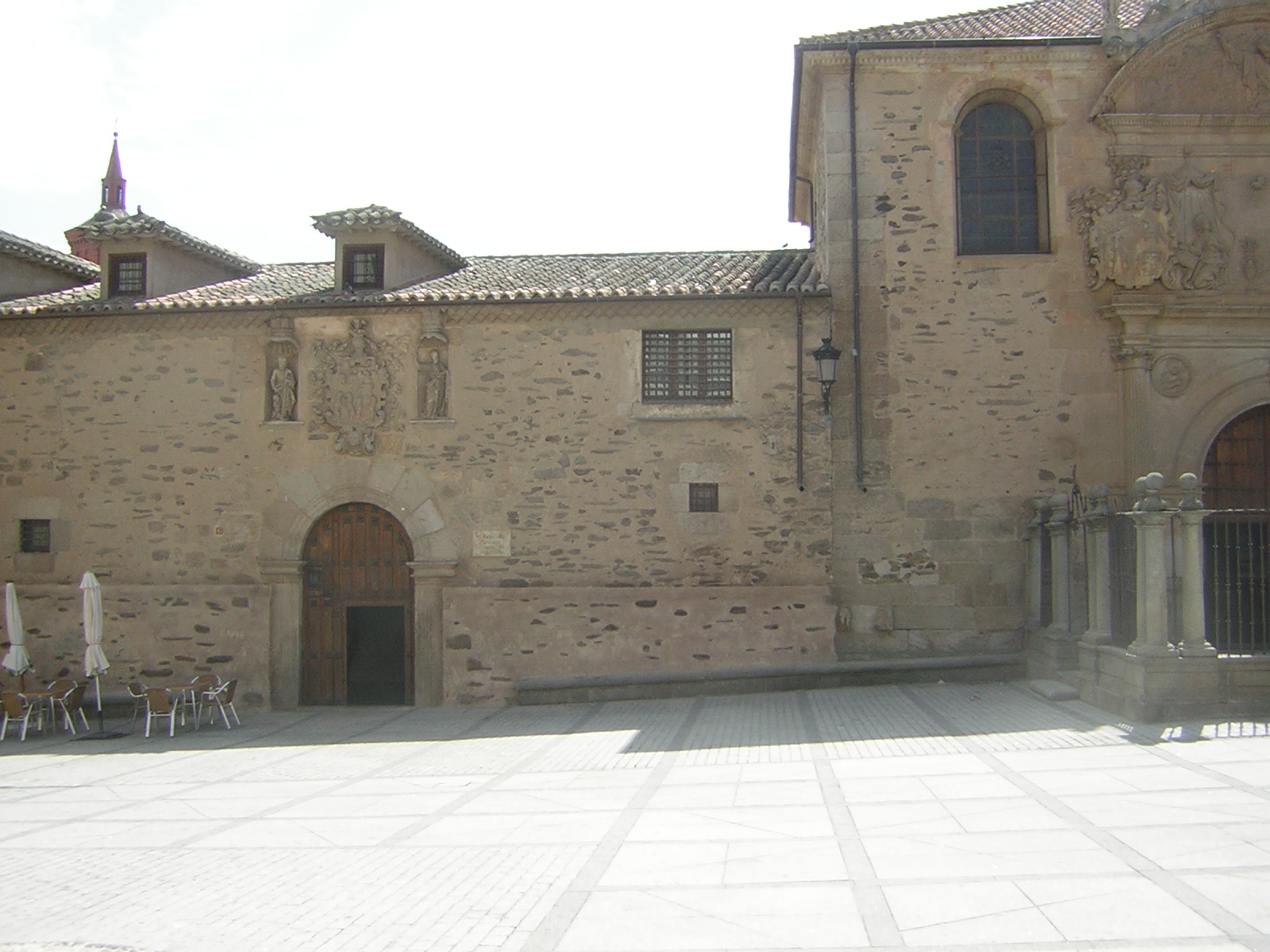
On the night of 4 October 1582, in a small cell in the lower part of the Carmelite convent at Alba de Tormes, St. Teresa of Ávila died. The date is fixed in history by a coincidence no one planned: it was the very night the Gregorian calendar reform took effect, when 4 October was followed by 15 October and the ten days between were excised from the calendar. Teresa's memorial is kept on 15 October because her death day, 4 October, belongs to St. Francis of Assisi.
She had arrived at the convent gravely ill on 20 September 1582 and lived her last fifteen days there. The convent she had come to was not new to her: she had founded it herself on 25 January 1571, the feast of the Conversion of St Paul — her eighth foundation, and the one that would become her place of death. (Her chronologically last foundations were Burgos and Granada in 1582; Alba is where she died, not her last foundation.)
What draws pilgrims here is what the convent has kept ever since. Teresa's incorrupt body rests above the tabernacle of the high altar, and two of her most eminent relics — her left arm and her heart — are enshrined separately beside it. The town sits on the River Tormes upstream from Salamanca, in the plain of Castile and León; beside the convent rises the great neo-Gothic basilica begun in 1898 and never finished, its towers and dome left incomplete as a visible mark of an ambition that outran its century.
📜 History & Spiritual Significance
The Convent of the Annunciation (Monasterio de la Anunciación de Nuestra Señora) was founded by St. Teresa of Jesús on 25 January 1571. The deed of foundation had been granted on 3 December 1570; the patrons were Francisco Vázquez and Teresa de Laíz, and Teresa's younger sister Juana de Ahumada and her husband Juan de Ovalle, who lived in the town, helped mediate the foundation. Teresa herself recorded: «Púsose el Santísimo Sacramento e hízose la fundación día de la conversión de san Pablo, año de 1571, para gloria y honra de Dios…».
Teresa returned to Alba de Tormes at the end of her life. Setting out from Burgos, she fell ill on the road and arrived gravely ill on 20 September 1582. She died in the arms of Ana de San Bartolomé on the night of 4 October 1582, and was buried in the convent.
The relic history of Alba begins soon after her death. Nine months after her burial the coffin was opened and the body was found intact, though the clothing had rotted; before re-interment a hand was cut off, wrapped in a scarf, and sent to Ávila. In 1585 the body was exhumed again to be moved to Ávila and was found incorrupt; at the nuns' request an arm was removed and left in Alba, while the rest was reburied in the Discalced Carmelite chapter house in Ávila. The body was afterwards brought back to Alba, where it has remained. After her canonization in 1622 the small convent church — originally intended as the founders' pantheon — became Teresa's pantheon, and the old main chapel was enlarged with royal patronage.
St. Teresa was canonized by Pope Gregory XV on 12 March 1622, alongside Ignatius of Loyola and Francis Xavier. Pope Paul VI declared her a Doctor of the Church on 27 September 1970 — the first woman so named, with Catherine of Siena — and she is known as Doctor orationis, the Doctor of Prayer. On 28 August 2024 a canonical recognition of the relics was carried out; the postulator general of the Discalced Carmelites, Marco Chiesa, reported that the body was in the same condition as when it was last opened in 1914, and it was publicly exposed in May 2025.
☩ Pilgrimage Sites in Alba de Tormes
The Teresian sites of Alba cluster around the Plaza de Santa Teresa: the convent that holds the relics, the museum within it that preserves the cell of her death, and the unfinished basilica built over the convent's orchard.
Convent of the Annunciation
Monasterio de la Anunciación de Nuestra Señora, Carmelitas Descalzas
The Discalced Carmelite monastery founded by St. Teresa in 1571 is the spiritual heart of Alba de Tormes. The church has two clearly differentiated parts. The primitive church (1571–1582) has a nave with a wooden coffered ceiling (armadura de madera atirantada) and a square main chapel covered by a ribbed vault traced by Rodrigo Gil de Hontañón. After Teresa's death and her 1622 canonization the small church was insufficient, and from around 1660 a baroque enlargement — the Obra Real, aided by Philip IV and María de Austria — added sacristy, transept, dome, and presbytery designed by the Carmelite Juan de San José, together with two superimposed camarines (high and low).
The retablo mayor is the singular feature of the church. Teresa's incorrupt body is reserved above the tabernacle; her left arm and her heart were exposed behind two doors on either side of the altar, where the nuns could venerate them directly from the two camarines. Today the arm and heart are together, visible from the high camarín. The convent also preserves the founder tombs of the Ovalle and Galarza families.
Museo Carmelitano ("Teresa de Jesús en Alba de Tormes")
Opened in June 2014 and situated within the Convent of the Annunciation, the museum occupies three areas: the Sala de Santa Teresa, holding works of spiritual content and the cell where Teresa died — the room in which she was installed when she arrived gravely ill on 20 September 1582; the two camarines and adjacent rooms with the reliquary arm and heart; and a contiguous three-storey building displaying painting, sculpture, goldsmithing (orfebrería), vestments, banners, and other objects of conventual life. The museum shares the convent's address on the Plaza de Santa Teresa.
Basilica of St. Teresa (unfinished)
Basílica de Santa Teresa
A neo-Gothic basilica built over the convent's huerta (orchard) and some town houses, promoted by Bishop Tomás Cámara. The first stone was laid on 1 May 1898, and the basilica was designed by Enrique María de Repullés y Vargas, a leading Spanish historicist architect of the period. The project called for a crypt, three naves plus two chapel-aisles, a transept with polygonal gables, a deep apse with ambulatory (girola), a chapel in the manner of Burgos's Constable Chapel, and a great dome (cimborrio) surrounded by four towers, with two façade towers over a double portico.
The basilica was never completed. After Bishop Cámara's death in 1904 the works slowed and stopped in December 1914; they resumed from 1927 to 1932 under Bishop Frutos Valiente and were interrupted again; between 2007 and 2010 the presbytery and apsidal chapel were closed with a project by Ricardo Pérez Rodríguez-Navas. In 2015 the basilica hosted the Alba seat of Las Edades del Hombre. Its unfinished towers stand as the most visible landmark of the town.
🕯️ Annual Feast Days & Celebrations
Feast of St. Teresa of Ávila — October 15
The universal memorial of St. Teresa of Ávila, Doctor of the Church. At Alba the convent marks the day with a Eucaristía Solemne (Solemn Mass). Her liturgical memorial falls on 15 October because 4 October, the day she died, is the feast of St. Francis of Assisi.
Novena to St. Teresa of Jesús — October 14–22
A local Alba Teresian observance: a nine-day novena leading into the feast, observed annually at the convent.
Birthday of St. Teresa — March 28
The Fiesta del Nacimiento de Santa Teresa de Jesús, commemorating her birth on 28 March 1515, observed at the convent.
🛏️ Where to Stay
Hotel Alameda (hotel) — Family-run hotel-restaurant on Avenida de Juan Pablo II, 400 m from the town centre and the shrine of St. Teresa, with rooms and suites. Website ∙ Reserve this hotel
Don Fadrique (hotel) — Hotel and restaurant on the Salamanca–Alba de Tormes road at kilometre 17, a short drive from the town, with rooms and event facilities. Website
abba Fonseca Hotel ⭐⭐⭐⭐ — Four-star hotel in Salamanca's Plaza de San Blas, about 20 km from Alba de Tormes, a practical base for visiting the shrine. Website
More hotels in Alba de Tormes on Booking.com →
Accommodation available to book near Alba de Tormes. Pilgrim houses and religious guesthouses are listed above — many take bookings directly and do not appear on booking sites.
🚗 Getting There
By Air: The nearest major airport is Madrid-Barajas (MAD), approximately 190 km east. Salamanca Matacán (SLM) is geographically closer; its scheduled passenger status is not confirmed here.
By Train: There is no passenger rail service at Alba de Tormes. The historic Vía de la Plata line passed through the municipality but is now a greenway (vía verde) with no train services. The nearest station with regular services is Salamanca, about 20 km west, on the Madrid–Galicia main line.
By Bus: Alba de Tormes has a bus station on Avenida de Juan Pablo II, with regular services to Salamanca — several frequencies per hour on weekdays, reduced on weekends and holidays — and to other localities and provincial capitals.
By Car: From Madrid, take the A-6/AP-6 motorway to Villacastín, then the A-50 to Salamanca, and the short road onward to Alba de Tormes (about 20 km from Salamanca).
📚 Further Reading
Books:
The Life of Saint Teresa of Ávila by Herself (Penguin Classics, trans. J. M. Cohen) — Teresa's autobiography, written under obedience: the primary first-person account of her life, her reform, and her final journey to Alba de Tormes.
Carmelite Ascent: An Introduction to St Teresa and St John of the Cross — Introduces the Carmelite reform Teresa led and her partnership with St. John of the Cross.
Teresa of Ávila (Turning To The Mystics) by James Finley — A modern introduction to Teresa's mystical teaching for pilgrims approaching her as the Doctor of Prayer.
🎥 Recommended Videos
El brazo y el corazón de Santa Teresa — Castilla y León Televisión (2014). On the arm and heart relics venerated in the Convent of the Annunciation — the core relic story of Alba de Tormes.
Reabren el sepulcro de Santa Teresa de Jesús — Exposición Teresiana (2024). Documents the 2024 canonical recognition of the sepulchre and relics at Alba de Tormes.
🔗 Useful Links
Monastery of the Annunciation, Alba de Tormes — The convent's official Carmelite site; first-class for the sepulchre, relics, museum, and visiting.
Diocese of Salamanca — Diocesan information and pastoral resources.
Castilla y León Tourism — Regional tourism portal with heritage information.
Turismo Alba de Tormes — The town's tourism site.
🧭 Nearby Pilgrimage Destinations
Ávila (71 km east) — St. Teresa's birthplace; the complementary Teresian pair — her life in Ávila, her death and relics in Alba.
Valladolid (113 km north) — Archdiocese seat and National Sanctuary of the Great Promise.
Burgos (226 km northeast) — Camino Francés, and one of Teresa's last foundations (1582).
Madrid (159 km east) — Gateway airport for international pilgrims.
Salamanca (20 km west) — The practical base for visiting Alba: university city and cathedral, and the rail hub. No dedicated guide yet.
🪶 Closing Reflection
"My Lord, it is time to move on. Well then, may your will be done. O my Lord and my Spouse, the hour that I have longed for has come. It is time to meet one another."


