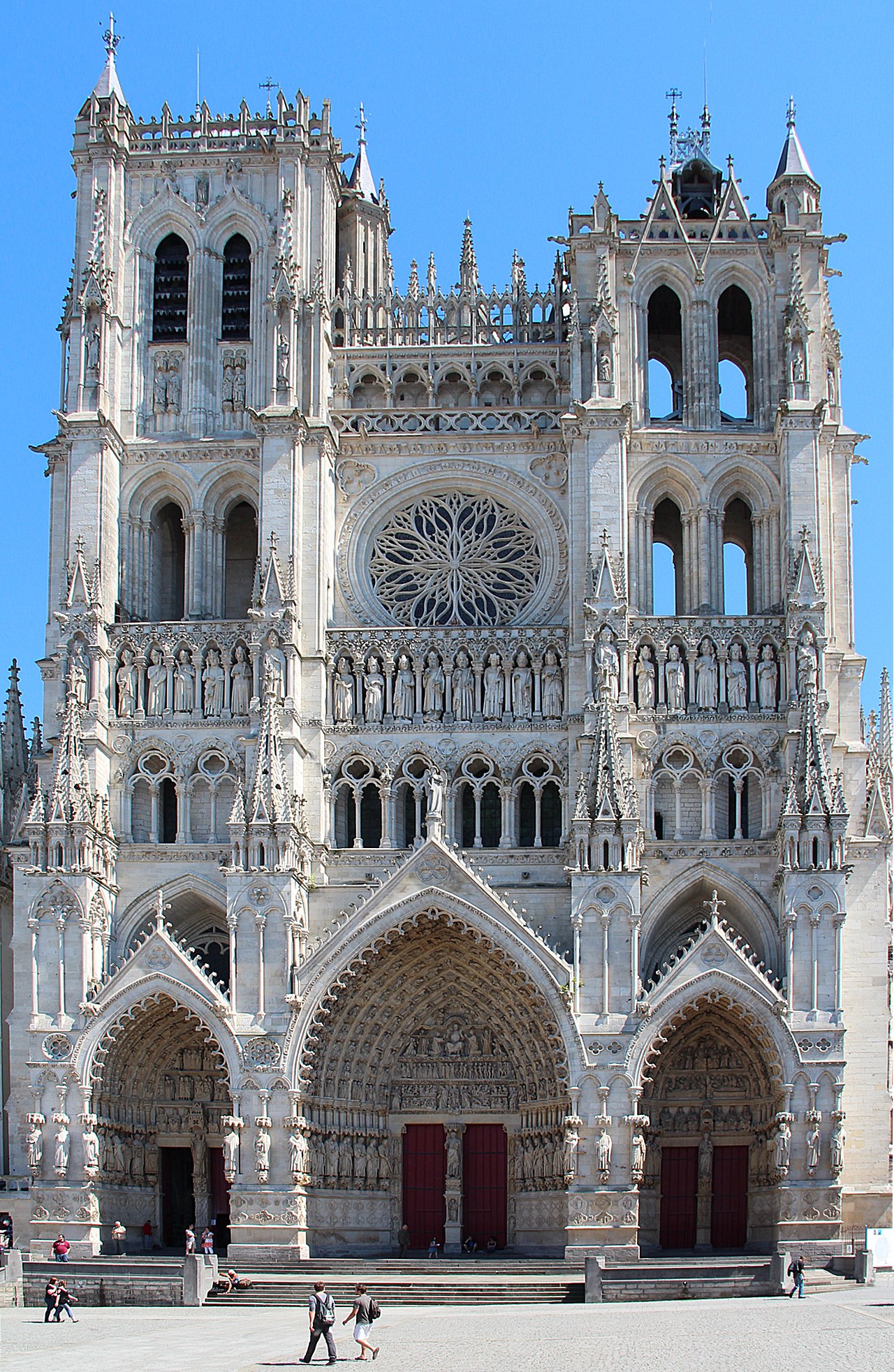
France keeps a great deal of its Catholic inheritance in plain suburban streets, and Argenteuil is one of them. The town lies on the northern edge of the Paris built-up area, about ten minutes by train from the Gare Saint-Lazare, in the Diocese of Pontoise. The basilica stands in the middle of it, on rue des Ouches, among houses and shops. sainte tunique shrine+2
What the town keeps is a length of woollen cloth. The Basilica of Saint-Denys of Argenteuil holds the Sainte Tunique, the Holy Tunic, venerated here since the time of Charlemagne as the seamless garment Christ wore before the Crucifixion. The cloth is not on view. Its surviving fragments are mounted on a backing cloth inside a reliquary set under the ciborium of the Tunic altar, in a side chapel off the nave, and the reliquary is normally closed. sainte tunique shrine+2
The opening of it sets the rhythm of the pilgrimage. Once a year, on the fifth Sunday of Lent, the closed reliquary is carried down into the choir and kept within reach of the faithful for the day. A full ostension — the cloth itself unrolled — has happened five times since 1900, the last through the Jubilee spring of 2025, when more than two hundred thousand people came. diocèse de pontoise+2
📜 History & Spiritual Significance
A garment without a seam. The Gospel of John records that the soldiers at the Crucifixion found Christ's tunic woven in one piece, without seam, and cast lots for it rather than tear it. Patristic and later Catholic tradition read the undivided garment as a figure of the Church's own unity, and that reading is the ground the devotion at Argenteuil stands on. Two ancient Western traditions venerate a garment held to be Christ's: this one, and the Holy Coat of the cathedral of Trier, in Germany, documented from about 1100 and shown publicly since 1512. The Catholic Encyclopedia of 1910 sets out both cases and settles neither; each side holds the other's relic genuine and differs only over which garment it is. A third tradition, Georgian and Orthodox, venerates the chiton beneath Svetitskhoveli Cathedral at Mtskheta. sainte tunique shrine+3
The gift of an empress. The tunic reached Argenteuil around the year 800, sent by the Byzantine empress Irene to Charlemagne as a diplomatic gift. He entrusted it to his daughter Theodrada, a nun and later abbess of the monastery at Argenteuil, and the monastery kept it. sainte tunique shrine+2
The charter of 1156. Norman raiders sacked Argenteuil in 850, and before they came the tunic was walled up in the priory; it was found again when the abbey was rebuilt. The first dated record of it is the Charte Hugonis of 1156, in which Hugh of Amiens, Archbishop of Rouen, describes examining the relic — then called the cappa pueri Jesu, the garment of the Child Jesus — and showing it publicly with King Louis VII present, granting an indulgence to those who came. From the fifteenth century the robe de Dieu drew the French court on pilgrimage: François I, Henri III, Louis XIII, Marie de Médicis, Anne of Austria and Cardinal Richelieu all came, and the processions that carried it through the town were large. sainte tunique shrine+3
The priest who cut the tunic. In 1793, with church property being confiscated, the parish priest of Argenteuil, Fr. Ozet, cut the tunic into pieces and buried some of them in his garden before he was imprisoned; the pieces he had given to parishioners for safe keeping were never recovered. Released two years later, he gathered what was left and had the surviving fragments sewn onto a plain backing cloth, which is how the relic has been kept since. wikipedia+2
What the examinations found. The cloth is wool, woven on a primitive loom with an unusually regular Z-twist and dyed with madder, a dye used by people of modest means rather than the purple of the rich. It measures 122 by 90 centimetres now, and about 148 by 90 at its full size. Bloodstains on it have typed as group AB, the group reported for the Shroud of Turin and the Sudarium of Oviedo as well. Pollen study found species shared with both of those cloths, two of them found nowhere but Palestine. Radiocarbon work carried out between 2003 and 2005 gave two ranges from two laboratories working on one sample, 530–650 and 670–880, and the researchers cautioned that centuries of water, fire, burial and mould make any single reading unsafe. wikipedia+3
The ostensions. A full unrolling of the relic was long a matter of once in about fifty years: 1900, 1934, and then Easter 1984, which drew eighty thousand people over six days. That showing followed a theft — the tunic and its reliquary were found missing in December 1983 and returned in February 1984, after an anonymous caller asked only for silence about the thieves. In 2016 the relic was restored, its deteriorating nineteenth-century satin support replaced with a new woollen backing, and shown again to about two hundred and twenty thousand people. The diocese then decided not to wait another half-century. The Jubilee ostension of 18 April to 11 May 2025 opened with a Good Friday Mass celebrated by Bishop Benoît Bertrand of Pontoise, who holds the title Guardian of the Holy Tunic, and drew more than two hundred thousand pilgrims. On 25 September 2026 the tunic was carried out of Argenteuil to the Stade de France for a vigil with young pilgrims, and Pope Leo XIV venerated it, the first pope to do so. wikipedia+5
The place itself. The church that holds the relic was built between 1862 and 1865 by the architect Théodore Ballu, in a neo-Romanesque manner, to replace a parish church the pilgrimage had outgrown; the tunic moved into it in 1865, and Leo XIII raised it to a minor basilica on account of that pilgrimage. The Tunic altar stands in a side chapel under a ciborium, and the reliquary beneath it is two nested cases, an inner one made in 1900 set within a gilt-bronze Gothic-revival case of 1827. Fifty-seven plaques on the walls record healings, graces and conversions asked for and received through the tunic's intercession. On most days there is nothing to see but the closed reliquary and the plaques, and that is what most pilgrims come to. wikipedia+1
☩ Pilgrimage Sites in Argenteuil
Basilica of Saint-Denys of Argenteuil
Basilique Saint-Denys d'Argenteuil
One site, one visit. The basilica is a parish church that keeps a relic: the Holy Tunic in its reliquary under the ciborium of the Tunic altar, in a side chapel off the nave, with the ex-voto plaques of the healed around it. The reliquary is normally closed, and the shrine's own site carries the times of Mass, the date of the annual veneration and any announced ostension. wikipedia+1
🕯️ Annual Feast Days & Celebrations
Journée de vénération de la Sainte Tunique — Fifth Sunday of Lent
The one fixed date in the shrine's year. The reliquary is brought down from the Tunic altar into the choir and kept within reach of the faithful through the day, closed, with Mass, the Way of the Cross and Vespers around it. The programme and the bishop or cardinal who presides change from year to year and are published on the diocese's page for the day.
🛏️ Where to Stay
Campanile Argenteuil ⭐⭐⭐ — A hotel-restaurant on Rue Ary Scheffer, about two kilometres from the centre of Argenteuil, with air-conditioned and non-smoking rooms, private parking, a bar and a restaurant; pets are accepted. argenteuil.campanile.com ∙ Reserve this hotel
More hotels in Argenteuil on Booking.com →
Accommodation available to book near Argenteuil. Pilgrim houses and religious guesthouses are listed above — many take bookings directly and do not appear on booking sites.
🚗 Getting There
By Train: Argenteuil is on Transilien Ligne J out of Paris Gare Saint-Lazare, a journey the shrine gives as about ten minutes. SNCF's departure boards for Argenteuil and Val d'Argenteuil show trains toward Saint-Lazare every eight to fifteen minutes through the day, alongside services to Ermont-Eaubonne, Pontoise, Mantes-la-Jolie and Gisors. From the station the basilica is about ten minutes on foot by rue Paul-Vaillant-Couturier, or one stop on bus line 272.
By Car: About twenty minutes from Paris. The A15 and the A86 each have an exit marked "Argenteuil Centre", five and two kilometres from the town centre respectively.
📚 Further Reading
Books:
Jean-Christian Petitfils. La sainte tunique d'Argenteuil : Authentique relique de la Passion du Christ — The current historical and scientific study of the relic, in French; cited by the basilica's rector and in the press coverage of the 2025 ostension.
Grzegorz Górny and Janusz Rosikon. Witnesses to Mystery: Investigations into Christ's Relics — A photographic survey of the relics of the Passion, with a section on the Tunic of Argenteuil and photographs of the 2016 showing.
🎥 Recommended Videos
Tunic of Christ | In Search of Holy Treasure by Great Documentaries — An English-language documentary on the tunic, its history and the examinations made of it.
🔗 Useful Links
Sanctuaire de la Sainte Tunique — The basilica's own site: the history of the relic, the times of Mass, and any announced ostension.
Diocese of Pontoise — Vénération de la Sainte Tunique — The diocesan page for the annual day of veneration, with the year's programme.
Tunique d'Argenteuil — The fullest account of the relic's documented history, in French.
🧭 Nearby Pilgrimage Destinations
Paris (13 km southeast) — The capital keeps the Crown of Thorns, the incorrupt body of St. Catherine Labouré, and perpetual adoration at Sacré-Cœur.
Chartres (78 km southwest) — The Gothic cathedral of the Veil of the Virgin Mary, a Marian sanctuary for nearly a thousand years.
Amiens (106 km north) — France's largest cathedral by interior volume, holding the relic venerated as the face of St. John the Baptist.
Reims (135 km east) — The coronation cathedral of the kings of France, beside the basilica that holds the tomb of Saint Remi.
Lisieux (148 km west) — Where St. Thérèse of the Child Jesus lived, died and taught her Little Way; France's most visited shrine after Lourdes.
🪶 Closing Reflection
"This tunic has been cut up throughout history. It alone tells us how much we must pray to restore unity. We cannot fish with a torn net, and we cannot wrap the body of Christ in a torn garment."
— Bishop Benoît Bertrand of Pontoise, Guardian of the Holy Tunic, to OSV News, 2025
Sources
- 1Sainte Tunique shrine – La Sainte Tunique d'ArgenteuilFrenchsaintetunique.com
- 2Catholic Review – Pilgrims venerating Holy Tunic of Jesus in France pray for cardinals in RomeEnglishcatholicreview.org/pilgrims-venerating-holy-tunic-of-jesus-in-france-pray-for-cardinals-in-rome
- 3Diocèse de Pontoise – Vénération de la Sainte Tunique à ArgenteuilFrenchcatholique95.fr/veneration-de-la-sainte-tunique-a-argenteuil
- 4Catholic Encyclopedia (1910) – The Holy CoatEnglishnewadvent.org/cathen/07400b.htm
- 5Wikipédia – Tunique d'ArgenteuilFrenchfr.wikipedia.org/wiki/Tunique_d'Argenteuil
- 6Wikipedia – Seamless robe of JesusEnglishen.wikipedia.org/wiki/Seamless_robe_of_Jesus
- 7Roman Catholic Saints – Our Lady of ArgenteuilEnglishroman-catholic-saints.com/our-lady-of-argenteuil.html
- 8Sindonological Lexicon – Tunic of ArgenteuilEnglishleksykonsyndonologiczny.pl/en/history-of-the-research-on-the-shroud/comparative-analyses/tunic-of-argenteuil
- 9EWTN News – Record numbers of pilgrims flock to see the Holy Tunic of Christ near ParisEnglishewtnnews.com/world/europe/record-numbers-of-pilgrims-flock-to-see-the-holy-tunic-of-christ-near-paris
- 10Catholic Review – Pope Leo XIV to make historic first veneration of Holy Tunic, highlighting Christian unityEnglishcatholicreview.org/pope-leo-xiv-to-make-historic-first-veneration-of-holy-tunic-highlighting-christian-unity
Last updated: