Pilgrimage Sites in France
Discover 41 sacred destinations in France
The Virgin Mary appeared to Bernadette Soubirous at Lourdes in 1858, and the shrine that followed is the most visited Marian destination in the world. France carries an unusual density of approved apparitions besides it: La Salette, to two children in 1846; Pontmain, to four children in 1871; Pellevoisin, to Estelle Faguette in 1876; Saint-Étienne-le-Laus, the longest approved apparitions in the history of the Church; and Cotignac, the only village where all three members of the Holy Family are held to have appeared.
The saints are as thickly settled. St. Thérèse was born at Alençon and died at Lisieux, the country's second pilgrimage destination after Lourdes. Bernadette's incorrupt body lies at Nevers, and that of St. John Vianney at Ars. At Paray-le-Monial Christ revealed his Sacred Heart to St. Margaret Mary Alacoque. The relics of Mary Magdalene are venerated at Vézelay and Saint-Maximin, and the grotto where she is said to have lived as a hermit for thirty years is at Plan-d'Aups-Sainte-Baume, reached on the 300 km Chemin de Marie-Madeleine. St. Joan of Arc was born at Domrémy in the Vosges, led Charles VII to his coronation at Reims in 1429, and was burned at Rouen two years later; she left no relics, and her shrine is the basilica on the hillside above her village.
Then the roads and the great churches. Le Puy-en-Velay, home of a Black Virgin, begins the 730 km Via Podiensis through Conques to the Pyrenees. Chartres keeps the Veil of the Virgin, and the Pentecost pilgrimage walks 100 km from Paris to reach it. Mont-Saint-Michel rises from its bay, and Rocamadour clings to a cliff around its Black Madonna. Paris holds the Crown of Thorns and the incorrupt body of St. Catherine Labouré, and Taizé gathers more than a hundred thousand young people.

Alençon
Birthplace of St. Thérèse of Lisieux, and the town whose basilica saw the marriage of her parents, Saints Louis and Zélie Martin.
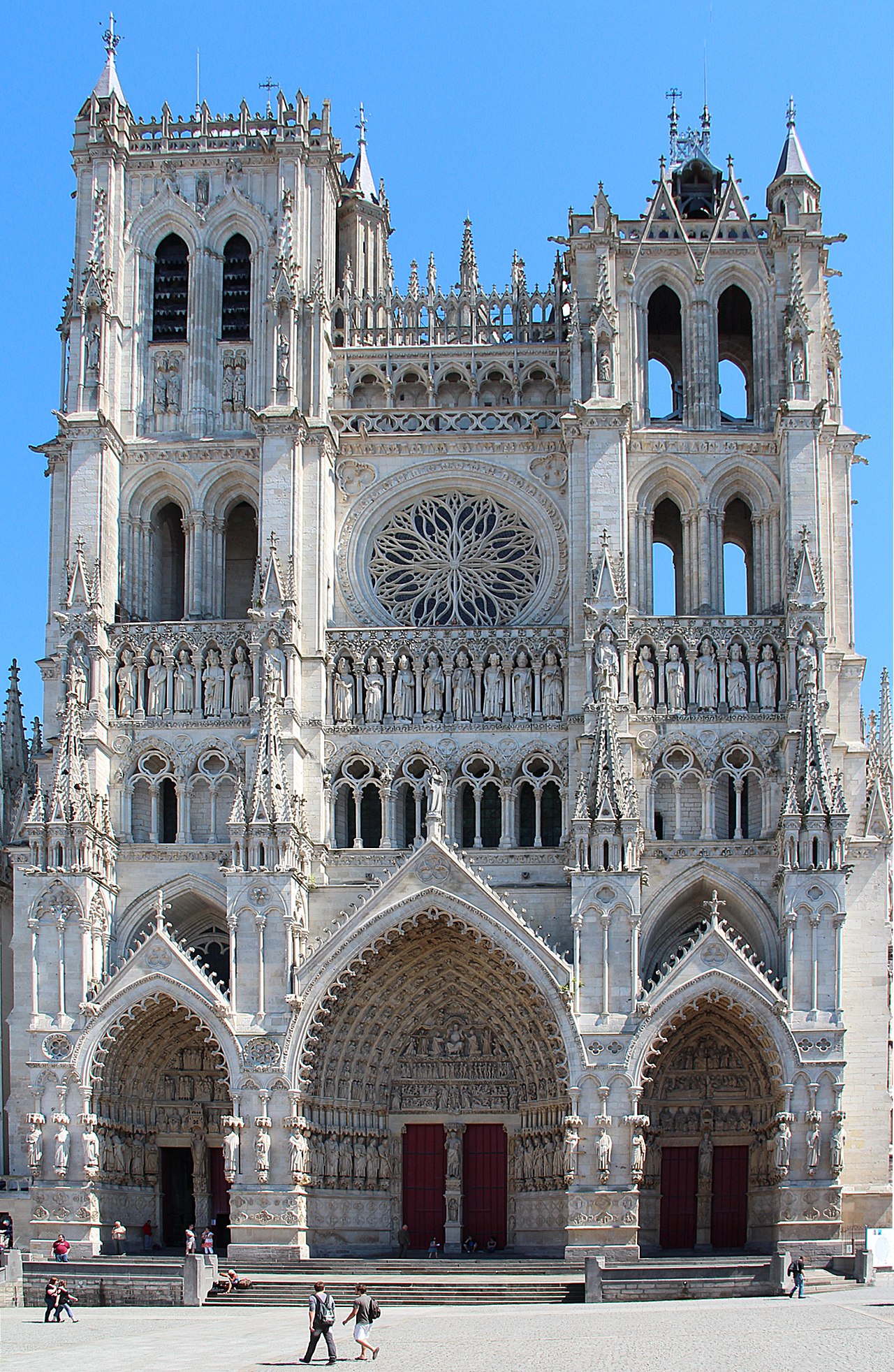
Amiens
Amiens Cathedral, the largest cathedral in France by interior volume and a UNESCO World Heritage site, houses a relic venerated as the face of St. John the Baptist — the front of a skull carried back from Constantinople during the Fourth Crusade in 1206.

Apt
Ancient cathedral claiming St. Anne's body relics since Charlemagne's time, with two Romanesque crypts and the mysterious Veil of St. Anne.

Ars
The incorrupt body of St. John Vianney, patron of parish priests, rests in this village where he spent 41 years hearing confessions.

Avignon
Seven popes ruled the Western Church from Avignon between 1309 and 1378, from the great Gothic palace that stands beside its cathedral.

Blanot
Côte-d'Or
Site of the 1331 Eucharistic Miracle where a Host fragment transformed to blood before witnesses, with the relic exposed annually on Easter Monday.

Brive
Brive is home to the ancient Caves of Saint Anthony of Padua, where pilgrims have sought spiritual refuge since the 13th century.

Chartres
Chartres Cathedral houses the sacred Veil of the Virgin Mary, drawing pilgrims for nearly 1,000 years to this Gothic masterpiece and Marian sanctuary.

Conques
Conques stands on the Via Podiensis to Compostela, around the abbey church of Sainte-Foy and its Romanesque reliquary treasure.

Cotignac
Cotignac is the world's only village where all three members of the Holy Family appeared, a premier Catholic pilgrimage destination in Provence.

Faverney
Haute-Saône
Site of the 1608 miracle where a monstrance suspended in mid-air for 33 hours during a fire, with the preserved Host venerated each Whit Monday.

La Salette
La Salette is where the Virgin Mary appeared to two children in 1846, bringing a message of reconciliation and conversion.

Lalouvesc
Mountain shrine where St. John Francis Regis died in 1640 and St. Thérèse Couderc founded the Cenacle in 1826.

Le Puy-en-Velay
Le Puy-en-Velay is one of France's oldest Marian pilgrimage sites, home to the Black Virgin and a major starting point for the Camino de Santiago.

Lyon
Lyon is a major Catholic pilgrimage site, home to the Basilica of Notre-Dame de Fourvière, a Marian shrine since 1170.

Lisieux
Where St. Thérèse of the Child Jesus lived, died, and taught her 'Little Way' — France's most visited shrine after Lourdes.

Lourdes
The Virgin Mary appeared to Bernadette Soubirous here in 1858, making Lourdes the world's most visited Marian shrine.

Marseille
Marseille is a major Catholic pilgrimage destination centred on the Notre-Dame de la Garde basilica, known for its Assumption Day pilgrimages.

Mont-Saint-Michel
A majestic medieval abbey dedicated to Archangel Michael, one of Europe's most important pilgrimage destinations for over a millennium.

Neuvy-Saint-Sépulchre
Indre
Home to the two drops of Christ's blood brought from Calvary in 1257, venerated in the Holy Sepulchre replica basilica for over 700 years.

Nevers
Burial place of St. Bernadette Soubirous, whose incorrupt body lies in a crystal reliquary at the Saint-Gildard sanctuary.

Nice
Nice keeps the relics of St. Reparata in its Baroque cathedral and the Art Deco national sanctuary of Our Lady Help of Christians.

Paray-le-Monial
The Burgundian town where Christ revealed His Sacred Heart to St. Margaret Mary Alacoque, and a major Catholic pilgrimage destination since.

Paris
France's capital houses the Crown of Thorns at Notre-Dame, St. Catherine Labouré's incorrupt body, and perpetual adoration at Sacré-Cœur since 1885.

Pellevoisin
Pellevoisin is a Catholic pilgrimage site where Our Lady appeared to Estelle Faguette in 1876, giving the White Scapular of the Sacred Heart.

Plan-d'Aups-Sainte-Baume
Grotto where Mary Magdalene lived as a hermit for 30 years — one of Christianity's oldest pilgrimage sites, run by the Dominican sanctuary.

Pontmain
Pontmain is a major Marian pilgrimage site where Our Lady appeared to four children in 1871, bringing hope during the Franco-Prussian War.

Reims
Reims is where the kings of France were crowned, in a Gothic cathedral beside the basilica holding the tomb of Saint Remi.

Rocamadour
In 1166 a priest digging by the cliff chapel found an undecayed body, taken for the hermit Amadour whose name the place carries.

Saint-Étienne-le-Laus
Site of the longest approved Marian apparitions in Church history: Our Lady appeared to Benoîte Rencurel for 54 years, from 1664 to 1718.

Saint-Gilles
Saint-Gilles keeps the tomb of its saint beneath a Romanesque abbey church, a stage on the Voie d'Arles to Compostela.

Saint-Maximin-la-Sainte-Baume
The Gothic basilica of Saint-Maximin holds the relics of St. Mary Magdalene, the Apostle to the Apostles, in its crypt.

Sainte-Anne-d'Auray
Sainte-Anne-d'Auray is Brittany's most important pilgrimage site where Saint Anne appeared in 1624, making it France's third major Catholic shrine.

Saintes-Maries-de-la-Mer
This Camargue village holds the relics of the two Maries and of Saint Sara, honoured in processions to the sea each May and October.

Souvigny
Eldest daughter of Cluny, Souvigny shelters the shared tomb of Saints Mayeul and Odilo, two abbots of Cluny venerated since the eleventh century.

Taizé
Taizé is one of the world's most important Christian pilgrimage sites, attracting over 100,000 young people annually for prayer and reconciliation.

Toulouse
Toulouse keeps the tomb of Saint Saturnin, its first bishop, under the largest Romanesque church in France, and the relics of Thomas Aquinas.

Tours
Tours keeps the tomb of St. Martin, the 4th-century bishop called the 'Apostle of Gaul,' in the basilica built over it.

Trois-Épis
Alsace's only Marian apparition site, where the Virgin Mary appeared to blacksmith Thierry Schoeré in 1491 holding three wheat ears—a symbol of blessing and warning.

Vendeville
France's national sanctuary of Saint Rita, where a statue arrived in 1928 and now draws 120,000 pilgrims seeking the Patroness of Impossible Causes.

Vézelay
Vézelay houses relics of St. Mary Magdalene in a UNESCO World Heritage basilica, a starting point for the Way of St. James.