A fragment of human bone rests inside a sphere of rock crystal on a gilded silver tray — the front of a skull, from forehead to upper jaw, that the faithful venerate as the face of St. John the Baptist. It arrived in Amiens on a December morning in 1206, carried home from the sacked palaces of Constantinople by a Picard crusader named Wallon de Sarton, who had found it beneath Greek lettering that named it the Forerunner's. The relic was received at the city gates by Bishop Richard of Gerberoy on the third Sunday of Advent, and within fourteen years the town had begun raising the largest cathedral France had ever seen to enshrine it.
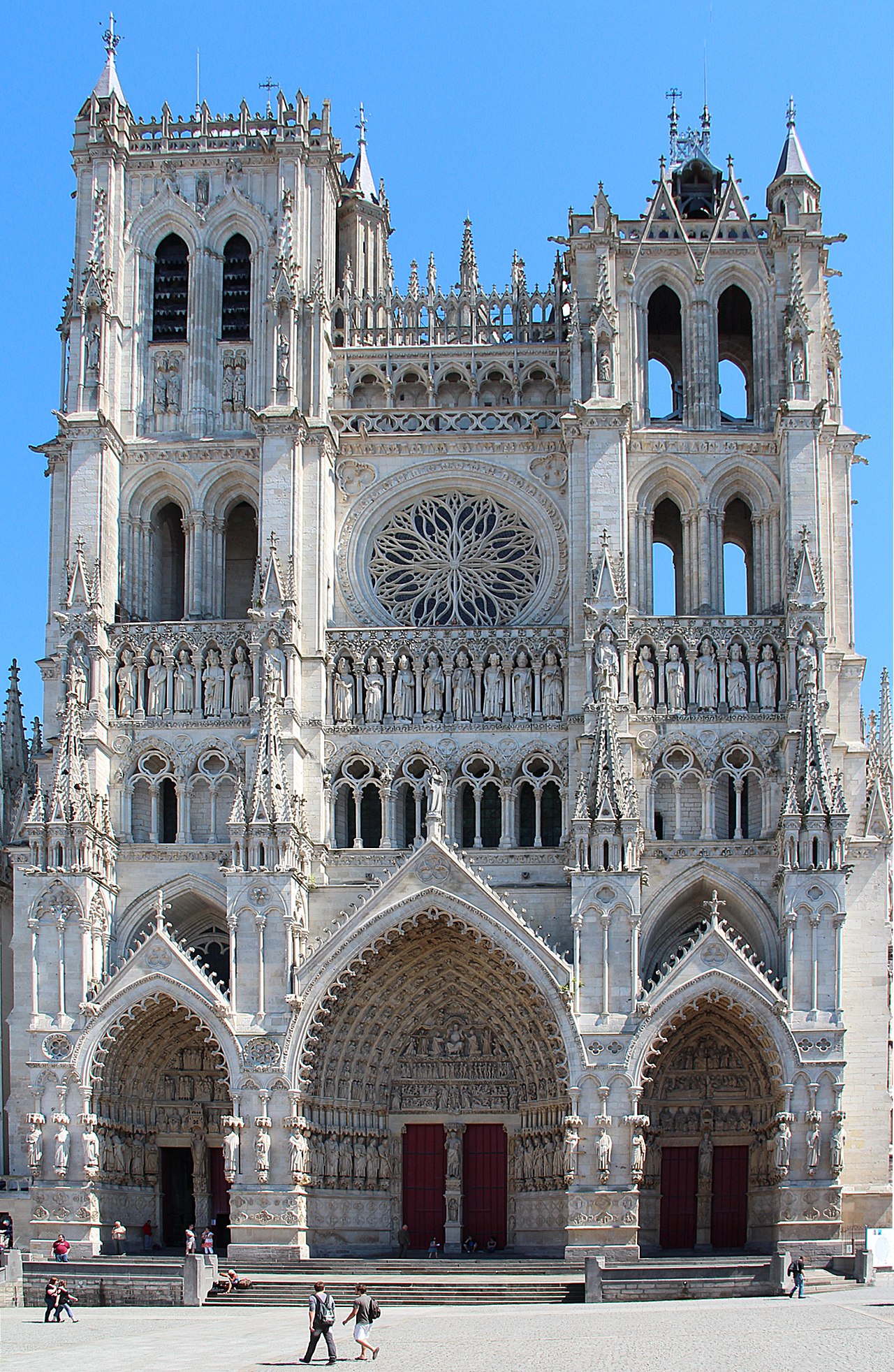
Cathédrale Notre-Dame d'Amiens still stands as the supreme expression of High Gothic ambition. Its vault soars to 42.3 metres — the highest nave in France — and encloses some 200,000 cubic metres of interior space, more than twice the volume of Notre-Dame de Paris. UNESCO inscribed it as a World Heritage Site in 1981, and eight centuries of pilgrims have come not only for the Baptist's relic but for a polychrome west front whose medieval colour the 1990s laser cleaning recovered, for a labyrinth walked since 1288, and for a single limestone angel who weeps over a skull in the south ambulatory.
📜 History & Spiritual Significance
A cathedral had stood on this ground for centuries before the present building. Its predecessor was destroyed by fire in 1218, but the decisive event came two years earlier, in 1206, when the relic of St. John the Baptist reached Amiens. The arrival transformed the city: the new Gothic cathedral, begun in 1220, was conceived from the first as a worthy reliquary in stone for the Forerunner's face.
Bishop Évrard de Fouilloy laid the first stone. The architect Robert de Luzarches began the design and worked on it until 1223; he was succeeded by Thomas de Cormont (1223–1228) and then by Thomas's son Renaud de Cormont (1228–1288). This remarkable continuity of master builders gives Amiens its celebrated architectural unity — a single, coherent vision carried through nearly seventy years of construction. Structural work was substantially complete by 1269, and the roof framework was laid between 1284 and 1305. The financing was bolstered by the regional trade in woad, the blue dye plant, and botanical ornament recalling that trade survives on the south nave exterior and west facade.
The cathedral's sheer scale was an act of devotion as much as engineering. At 145 metres long, with a vault rising to 42.3 metres and an interior volume of roughly 200,000 cubic metres, Amiens is the largest cathedral in France by interior volume — frequently cited as the largest Gothic cathedral in the land, and by some measures in the medieval world. It contains more than 4,000 sculpted figures across its stalls and choir screens.
Later centuries left their marks. In the sixteenth century a flamboyant rose window was inserted in the west front and the choir stalls and screens installed. The eighteenth century brought wrought-iron railings in place of the rood screen and a Baroque altar in accordance with the Council of Trent. In the nineteenth century Eugène Viollet-le-Duc led a major restoration between 1849 and 1874. The cathedral celebrated its 800th anniversary in 2020.
The relic's own story is inseparable from the Fourth Crusade. In the ruins of a Constantinople palace, Wallon de Sarton found a half-sphere of transparent crystal containing the facial section of a human head resting on a silver plate, with Greek lettering identifying it as John the Baptist's. He sold the silver plate to fund his voyage home but kept the head, and presented it to the Bishop of Amiens in 1206. The reliquary seen today — a rock-crystal setting on a gilded silver tray adorned with semi-precious stones and an enamel-and-silver mask — was completed in the nineteenth century, after the original treasury disappeared during the Revolution.
A competing claim exists, and the cathedral does not stand alone in its devotion. The Roman church of San Silvestro in Capite — in capite, "of the head" — holds a reliquary that Western tradition likewise identifies as John's skull, likewise said to have come from Constantinople. The two claims stand side by side, as they have for centuries; the Amiens relic is the front of a skull, the facial skeleton, while Rome's is described as the top portion of the skull. Neither site resolves the other, and pilgrims who reverence either honour the same Forerunner of Christ.
☩ Pilgrimage Sites in Amiens
Cathédrale Notre-Dame d'Amiens
Cathedral of Our Lady of Amiens
The largest cathedral in France by interior volume rises above the River Somme in the heart of the old Picard capital. Begun in 1220 and substantially complete by 1269, it is the supreme achievement of High Gothic architecture — a single, unified design carried through by three master builders across nearly seven decades. The vault soars to 42.3 metres, the highest nave in France, and the interior volume of some 200,000 cubic metres is more than double that of Notre-Dame de Paris. UNESCO inscribed the cathedral as a World Heritage Site in 1981, recognising both its architecture and its furnishings.
The Relic of the Head of St. John the Baptist
The cathedral's reason for being is the relic that arrived in 1206 — the front of a skull, from forehead to upper jaw, venerated as the face of St. John the Baptist. Wallon de Sarton, a crusader from Picardy, found it during the Fourth Crusade in the ruins of a Constantinople palace, resting in a sphere of transparent crystal on a silver plate inscribed in Greek with the Forerunner's name. He sold the plate to fund his return but kept the head, and presented it to the Bishop of Amiens, who received it solemnly at the city gates on 17 December 1206. The relic is displayed in a nineteenth-century rock-crystal reliquary set on a gilded silver tray with semi-precious stones and an enamel-and-silver mask. A competing Roman claim — the church of San Silvestro in Capite holds what Western tradition identifies as the top of John's skull, likewise said to come from Constantinople — stands alongside the Amiens devotion without resolving it.
The Polychrome West Front
The west facade, with its three portals and twin towers, was once covered in vivid medieval colour. That colour was lost to centuries of grime until 1993–1995, when the south portal became the first monument in France to be cleaned by laser — a process of "photonic disencrustation" that vaporised the accumulated dirt without abrading the stone. The cleaning revealed rare surviving traces of the original thirteenth-century polychrome paint. Researchers, working with EDF's laboratories, reconstructed the original colour scheme and developed a lighting technique to project it back onto the facade with precision; on summer evenings and at Christmastime a multicolour light show called Chroma recreates the medieval polychromy on the west front, returning to the stonework something of its first brilliance.
The Nave Labyrinth
Set into the pavement of the fourth and fifth bays of the nave, the labyrinth was installed in 1288 and signed by the architect Renaud de Cormont. Its black-and-white octagonal geometric pattern runs a path of some 240 metres, and pilgrims historically walked it as a symbolic devotional journey — a "Road to Jerusalem" for those who could not travel to the Holy City. The central stone carries inlaid-marble portraits of the founding bishop and the cathedral's first three architects, with a copper inscription naming all four and recording 1220 as the year the foundation stone was laid. Unlike the labyrinth at Chartres, Amiens's did not survive the Revolution intact; the present pavement is an exact nineteenth-century copy, while the original central stone is preserved separately in the Musée de Picardie.
The Weeping Angel
In the south ambulatory, within the funerary monument of Canon Guilain Lucas de Genville (d. 1628), a small limestone angel sculpted by Nicolas Blasset in 1636 rests one hand on an hourglass and an elbow on a skull — a memento mori symbolising the brevity of life. Blasset, an Amiens-born sculptor made master in 1625, produced most of his religious and funerary work across Picardy. The Weeping Angel became one of the cathedral's most reproduced images: during the First World War, British and American soldiers fighting in the Somme sent postcards of the angel home, and it remains a beloved object of quiet devotion.
🕯️ Annual Feast Days & Celebrations
The Passion of St. John the Baptist — August 29
August 29 keeps the memorial of the beheading of John the Baptist, the death the Gospels of Mark and Matthew both narrate. At Amiens the date has a particular resonance, for the cathedral holds the relic venerated as the Forerunner's face. The memorial marks the martyrdom of the one who prepared the way of the Lord — imprisoned by Herod Antipas at Machaerus for denouncing the king's marriage to Herodias, and killed on an oath sworn at a birthday feast. Pilgrims who come to Amiens on or near this day venerate the relic that the cathedral was built to enshrine, joining a devotion that stretches from that December morning in 1206 to the present.
🛏️ Where to Stay
Mercure Amiens Cathédrale ⭐⭐⭐⭐ — Located just 50 metres from the cathedral, this four-star hotel offers the closest accommodation to Notre-Dame d'Amiens, with suites featuring balconies and panoramic cathedral views. A terrace and garden provide rare green space in the city centre, and the restaurant serves homemade dishes using local Picard ingredients. Website ∙ Reserve this hotel
Hôtel le Prieuré ⭐⭐⭐ — A charming three-star hotel housed in an eighteenth-century former canon's residence at the foot of the cathedral, on one of the old town's most picturesque streets. The 23 rooms are spread across two historic buildings; some offer cathedral views. A bar, terrace, and seminar room complete the facilities. Website ∙ Reserve this hotel
ibis Styles Amiens Centre ⭐⭐⭐ — A reliable mid-range option in the heart of the city, steps from the train station and a short walk from the cathedral. The all-inclusive rate covers room, breakfast, and WiFi; rooms feature bright, contemporary decor behind a listed eighteenth-century facade, with a patio bar for evening relaxation. Website ∙ Reserve this hotel
Hôtel de Normandie ⭐⭐ — A simple, good-value two-star hotel dating to 1920, located in a quiet street in the city centre near the train station and cathedral. The 28 rooms offer basic comforts with free WiFi, satellite television, and hypoallergenic bedding. An art deco breakfast room with stained-glass windows adds period character. Website ∙ Reserve this hotel
More hotels in Amiens on Booking.com →
Accommodation available to book near Amiens. Pilgrim houses and religious guesthouses are listed above — many take bookings directly and do not appear on booking sites.
🚗 Getting There
By Train: Direct TGV and TER services connect Paris Gare du Nord to Amiens in approximately one hour. Trains also run from Lille and from Calais, making Amiens an easy day trip or overnight from the capital.
By Air: The nearest major airport is Paris Charles de Gaulle (CDG), approximately 130 km to the south, with direct train connections to Amiens. Paris Beauvais–Tillé (BVA) is closer, around 80 km, served by low-cost carriers.
By Car: From Paris, take the A16 motorway north to Amiens, approximately 115 km and just over an hour. From Lille, the A29 and A16 connect in roughly two hours. Paid parking is available in the city centre near the cathedral.
On Foot: The Chemin d'Amiens, a 171-kilometre marked pilgrim route inaugurated in 2018 with a Compostelle nail laid before the cathedral, links Amiens Cathedral to Rouen in seven stages, forming part of the network of paths connecting Hauts-de-France to Normandy on the way toward Mont-Saint-Michel and Santiago.
📚 Further Reading
Books:
Stephen Murray, Notre-Dame of Amiens: Life of the Gothic Cathedral — The magisterial single-volume history of the cathedral, from its construction in 1220 through the sixteenth century, by the foremost living Amiens scholar. Columbia University Press, 2020.
John Ruskin, The Bible of Amiens — The classic nineteenth-century meditative study of the cathedral's facade and sculpture by the most influential Victorian art critic, who made Amiens a place of aesthetic pilgrimage for English readers. First published 1884.
Émile Mâle, The Gothic Image: Religious Art in France of the Thirteenth Century — The foundational study of thirteenth-century French religious iconography and the sculptural programmes of the great cathedrals, including Amiens. First published 1899.
Online Resources:
Cathédrale Notre-Dame d'Amiens — Official Website — Opening hours, the history of the monument, the relic, and visitor information maintained by the cathedral.
UNESCO World Heritage Centre — Amiens Cathedral — The 1981 inscription recognising the cathedral's architecture and furnishings.
🎥 Recommended Videos
Does Amiens Cathedral REALLY have the Head of John the Baptist? — An accessible English-language exploration of the relic claim and its history. Evelyn Edwards, 2025.
Amiens Cathedral, France. Relics of John the Baptist — A direct look at the relic of St. John the Baptist venerated at Amiens. Iceland Explorer, 2022.
Amiens Cathedral: Flyover in Virtual Reality — An architectural VR flyover of the cathedral, a fine visual companion. Myles Zhang, 2017.
🔗 Useful Links
Diocese of Amiens — Official diocesan website with parish information and pastoral resources.
Amiens Tourisme — Visitor information including accommodation, restaurants, and the city's cultural calendar.
SNCF Connect — Train timetables and booking for Paris–Amiens services.
🥾 Pilgrim Routes
Chemin d'Amiens — A 171-kilometre marked route from Amiens Cathedral to Rouen, inaugurated in 2018 with a Compostelle nail laid before the cathedral door. The seven-stage path forms part of the network linking Hauts-de-France to Normandy on the way toward Mont-Saint-Michel and the pilgrimage ways to Santiago de Compostela.
Via Francigena — The medieval pilgrim road from Canterbury to Rome, following Sigeric's tenth-century itinerary, runs through the Somme department east of Amiens on the GR145 long-distance footpath, passing through Peronne and Saint-Quentin. Pilgrims walking the Francigena can reach Amiens by a regional detour to venerate the relic of St. John the Baptist.
🧭 Nearby Pilgrimage Destinations
Paris (115 km south) — France's capital houses the Crown of Thorns at Notre-Dame Cathedral, the incorrupt body of St. Catherine Labouré at the Miraculous Medal Chapel, and perpetual Eucharistic adoration at Sacré-Cœur.
Reims (140 km east) — The cathedral where the kings of France were crowned, associated with St. Remigius and the baptism of Clovis, and home to the relic of the Holy Chrism.
Chartres (170 km southwest) — The Gothic cathedral housing the Veil of the Virgin Mary, with its medieval labyrinth and the celebrated "Chartres blue" glass.
Lisieux (170 km west) — France's second-greatest pilgrimage site after Lourdes, where St. Thérèse of the Child Jesus lived her Carmelite vocation and taught her "Little Way" of spiritual childhood.
🪶 Closing Reflection
"Among those born of women there has risen no one greater than John the Baptist."


