Around 1869, in the village of Olgossa in Darfur, a girl was born into a respected family of the Daju people. When slave traders seized her in 1877, they gave her the name Bakhita — Arabic for "fortunate". The name proved truer than they knew: the girl they marched barefoot to the slave markets of Sudan would one day rest beneath the altar of a church in the Alpine foothills of northern Italy, honoured by the whole Church as Saint Josephine Bakhita (c. 1869–1947).
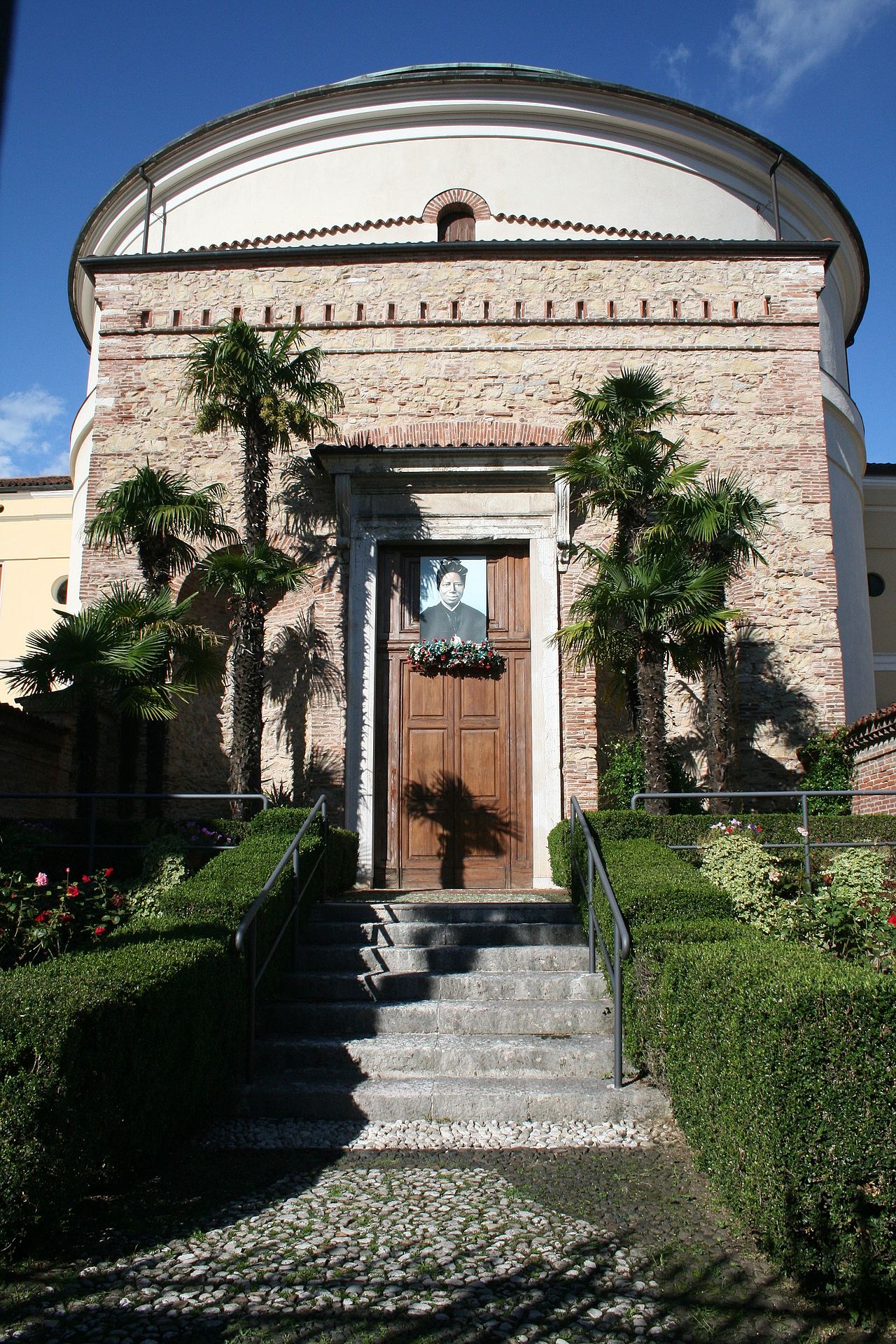
That church is the Church of the Holy Family, Chiesa della Sacra Famiglia, on via Fusinato in Schio, a town in the province of Vicenza, in the Veneto. The neoclassical rotunda belongs to the Canossian convent where Bakhita served as cook, sacristan and portress, and where the townspeople came to know her as the Madre Moretta, the "Black Mother". Her remains lie today beneath the main altar, and the church is known to pilgrims simply as the sanctuary of Saint Bakhita.
Pilgrims come to pray at the tomb of a woman the Church invokes as patron of Sudan and of the victims of human trafficking.
📜 History & Spiritual Significance
The church was built for the Canossian sisters. The first stone was laid in June 1850, carried in procession and blessed by the archpriest Monsignor Gaetano Greselin on land given by the benefactress Chiara Dalla Piazza; the design was the architect Bartolomeo Folladore's. The sisters of the Canossian congregation arrived in Schio in July 1864, at the prompting of Monsignor Alessandro Garbin, and moved into a building still unfinished — money had run out, and the works stood still for more than three decades. They resumed only in 1899, under Gioacchino Folladore, the architect's son, and the church was inaugurated in October 1901. Its façade was never completed: the classical portico the elder Folladore had planned was never built, and the rough brick front stands today much as the masons left it.
The saint who gave the church its present name was born around 1869 in Olgossa, west of Nyala near Mount Agilerei. "I lived a very happy and carefree life, without knowing what suffering was," she later wrote of her childhood. In 1877, when she was seven or eight, slave traders who had abducted her elder sister two years before seized her too; from the terror of it she forgot the name her parents had given her, and her captors called her Bakhita. Sold and resold in the markets of El Obeid and Khartoum, she passed from master to master, and in one household was marked in a scarification ritual — one hundred and fourteen cuts, rubbed with salt so the patterns stayed. In that house, she recalled, not a day passed without a wound.
Her last buyer was an Italian: Callisto Legnani, the vice-consul in Khartoum, who for the first time in her memory gave orders without the lash. When unrest forced him to leave Sudan, she begged to go with him. They escaped besieged Khartoum at the end of 1884, crossed 650 kilometres of desert on camelback to the Red Sea port of Suakin, and in April 1885 reached Genoa. Legnani entrusted her to friends, the Michieli family, at whose villa at Zianigo, near Mirano west of Venice, she became nursemaid to their daughter Mimmina, born in 1886.
When the Michielis returned to Africa, Bakhita and the child were left, on the advice of the family's administrator, with the Canossian sisters at the Institute of the Catechumens in Venice. There she came to know the God she says she had felt in her heart since childhood, watching the sun and the stars: "Who could be the Master of these beautiful things?" When her mistress came back to claim her, Bakhita refused to leave, and on 29 November 1889 the King's attorney ruled that she had never legally been a slave — slavery had no standing in Italian law. At about twenty years of age, she was free for the first time in her life, and free to choose. She chose to stay with the sisters.
On 9 January 1890 she received baptism, confirmation and her first Communion in Venice from Giuseppe Sarto — the future Pope Pius X. The baptismal name she took was Josephine Margaret Fortunata, Fortunata being the Italian for Bakhita. She entered the Canossian novitiate in December 1893, and on 8 December 1896 professed her vows, welcomed once again by Cardinal Sarto.
In 1902 the congregation transferred her to the convent at Schio, where she lived for the rest of her life — forty-five years, all but a posting to the missionary novitiate at Vimercate near Milan (1935–1939). She cooked, she kept the sacristy, she answered the convent door, laying her hands in blessing on the heads of the schoolchildren who passed her daily. Her gentleness and her ever-present smile won the town, and the children, fascinated by her skin, teased that she was made of chocolate. In 1931 the lay Canossian writer Ida Zanolini published her story, Storia meravigliosa ("Tale of Wonder"), and made her known across Italy. Through the Second World War the townspeople, who considered her a saint, felt protected by her presence; Schio did not escape the bombing of those years, but the war passed without a single casualty.
Her last years were long and painful, spent in a wheelchair; asked how she was, she would smile and answer: "As the Master desires." In her final agony her mind returned to slavery, and more than once she begged the nurse attending her: "Please, loosen the chains… they are heavy." Her last words were "Our Lady! Our Lady!" She died on 8 February 1947, about seventy-eight years old, surrounded by her sisters. For three days her body lay in the convent while thousands came from the town to see their Black Mother once more.
The cause for her canonization opened in 1959, twelve years after her death, under Pope John XXIII. In 1969 her remains were translated into the church where she had served; in 1978 Pope John Paul II proclaimed the heroicity of her virtues; on 17 May 1992 he beatified her in St Peter's, and on 1 October 2000, in the Great Jubilee, he canonized her — the first Black woman canonized in the modern era. Her feast is kept on 8 February, the day of her death.
Her tomb made the church a sanctuary. It was renewed for her beatification in 1992 and restored for her canonization in 2000, and a permanent exhibition on her life beside the convent was founded in 1992 and completed in 2000. Pope Benedict XVI opened his 2007 encyclical on hope, Spe Salvi, with her story; and for the Jubilee of Hope in 2025 the Bishop of Vicenza named her church a Jubilee church, its holy door opened on 5 January 2025.
☩ Pilgrimage Sites in Schio
Schio keeps the Bakhita pilgrimage in two places about half a kilometre apart: the Canossian sanctuary on via Fusinato, where the saint lived, died and lies, and the bronze monument raised to her beside the church of St Francis in the city centre.
Sanctuary of St. Josephine Bakhita — Church of the Holy Family
Santuario di Santa Bakhita — Chiesa della Sacra Famiglia
A small garden and a wrought-iron gate stand before the church, with the Canossian convent attached at either side. Two smiling images of St. Bakhita greet arriving pilgrims before they enter — one beside the garden, one above the main door. Inside is a circular hall built to one third of the proportions of the Pantheon in Rome: a coffered dome with a round oculus at its centre, the light falling evenly over sixteen paired Corinthian columns and four equal arches. The facade was never finished to Bartolomeo Folladore's design, and the niches flanking the door have stayed empty; what the sisters keep bright is the interior.
The pilgrimage gathers at the presbytery. Beneath the main altar lies the effigy of the saint — vested in the black habit of the Canossian order, a rosary in her clasped hands, her face and hands a mannequin's — and within the effigy, the bronze urn that holds her bones. The letters beneath name her as the town knew her: MADRE GIUSEPPINA BAKHITA, 1869–1947. She was buried first in a chapel at the side of the church; her remains were translated to the altar in 1969.
Side altars stand under the two side arches. On one, Our Lady holds the crucified Jesus across her lap in the manner of Michelangelo's Pietà; on the other is St. Magdalene of Canossa, who founded the sisters' congregation. High in the dome, four monochrome panels by Giuseppe Mincato show scenes of the Holy Family, the dedication the church carries, and a tapestry of the 1992 beatification hangs in the church.
Through the convent the sisters keep the exhibition they call the Mostra permanente and the Stanza del Transito, listed on the Ministry of Culture's register as the Museo di Santa Giuseppina Bakhita. It was founded for her beatification and completed for her canonization. Wall paintings by Mario Bogani of Como tell Bakhita's life; photographs show the house at Zianigo, near Mirano, where she first served a family in Italy; a showcase recalls Olgossa, her Darfur home village, with African instruments; the documents include the honorary citizenship Schio conferred on her. Relics and objects that were hers, ex voto and testimonies of graces received, fill the remaining cases. The exhibition and the Stanza del Transito open on the sanctuary's open days, 9:00–11:30 and 15:30–18:00, closed Mondays; groups book through the form on the sisters' visit page, which also carries the church's opening and Mass times.
"Let the Oppressed Go Free" Monument
Santa Bakhita libera gli oppressi
Beside the church of St Francis stands six metres of bronze: St. Bakhita lifting a trapdoor in the ground while about a hundred figures climb out of it into the light. The Canadian sculptor Timothy Schmalz took the work's title from Isaiah 58:6, and gave every figure one face of the traffic in human beings — the domestic slave, the child soldier, the child bride, and at the front a newborn, added at the request of Sister Gabriella Bottani of the anti-trafficking network Talitha Kum. Pope Francis wanted the work, an idea that came from Cardinal Michael Czerny after Schmalz's Angels Unawares was placed in St Peter's Square; the Rudolph P. Bratty Family Foundation paid for it, and the Schio bronze is the original. Cardinal Pietro Parolin, the Vatican's Secretary of State, blessed it on 29 June 2023, the feast of St Peter, Schio's patron, before a crowd of nearly a thousand people, who then walked in procession to the cathedral for Mass.
🕯️ Annual Feast Days & Celebrations
Feast of St. Josephine Bakhita — February 8
February 8, the day Bakhita died at the Canossian convent in 1947, is her feast throughout the Church — the date given her at her beatification in 1992. At Schio it is the town's principal celebration. The Canossian sisters prepare with a novena and a triduum of adoration and vespers with testimonies, and each year the celebrations take a theme chosen together by the sisters, the local parish and the Bakhita Schio-Sudan Association — a different theme every year. For the 2020 feast the solemnity was kept with six Eucharistic celebrations through the day and a vigil for young people against human trafficking; a festive Mass with civil and military authorities has marked the day (in 2025 it was held in the cathedral of San Pietro). The centre of the day is the sanctuary itself, where her remains lie under the main altar.
February, the Month of Bakhita — throughout February
The feast opens a whole month in Bakhita's name. "Febbraio mese di Bakhita" is a city programme of Masses, conferences, concerts and cultural evenings kept by the Bakhita Schio-Sudan Association together with the Canossian mothers under the patronage of the town — each year the first poster announcing the month is carried up to the church of Santa Maria del Summano on the mountain that watches over Schio. Offerings gathered at the events support school and professional-training projects in South Sudan, the land of Bakhita's birth.
International Day of Prayer and Awareness Against Human Trafficking — February 8
On Bakhita's feast the Church keeps its worldwide day of prayer against human trafficking, first held in 2015, promoted by the Holy See's pontifical councils together with the International Union of Superiors General. At Schio the day and the feast are one: the saint who was herself sold in the slave markets is invoked as patron of all who are trafficked today, and her tomb is the day's natural place of prayer.
🛏️ Where to Stay
Schio is a working town, not a resort, and the choice is honest rather than large. The sanctuary itself keeps no guesthouse — the Canossian sisters run a school beside the Church of the Holy Family — so pilgrims sleep in the town around them. Everything below sits within the municipality of Schio: two hotels and a holiday house in the town itself, and a farm-stay and a parish house in the Tretto hills above it.
Le Scuderie di Santa Bakhita (apartment) — A restored holiday house a few metres from the sanctuary, named for the saint and standing on the Romea Strata pilgrim way. Two bedrooms (six beds in all), a day room with kitchen, and a porch overlooking a garden; the railway station is 500 m away, so pilgrims arriving by train can walk with their bags. Booked directly with the owners through their website. Website
Hotel Miramonti ⭐⭐⭐⭐ — A four-star hotel on via Marconi, facing the town hall square in the centre of Schio; secure private parking. Website ∙ Reserve this hotel
Schio Hotel (hotel) — A hotel between the historic centre and the industrial zone, five minutes by car from the centre of Schio; a garden restaurant serving Veneto specialities and free monitored parking. Website ∙ Reserve this hotel
Agriturismo Il Maggiociondolo (agriturismo) — A farm-stay on the green Tretto plateau above the town, at about 700 metres' altitude and fifteen minutes' drive from the centre of Schio; spacious en-suite rooms furnished in rural style, breakfasts from the farm's own produce, and the silence of the Vicentine pre-Alps. Booked directly with the owners through their website. Website
Casa Alpina Villa Maria (pilgrim accommodation) — A mountain house owned by the parish of San Pietro — the parish of the pastoral unit named for St. Bakhita — at Bosco di Tretto, 783 m above sea level and about 12 km from the sanctuary. Volunteer-run, with around thirty beds and a large park, it is built for groups (school camps, scouts, spiritual encounters) rather than individual travellers; the parish website carries the booking email, and the neighbouring Casa San Giuseppe adds eighteen beds. Website
More hotels in Schio on Booking.com →
Accommodation available to book near Schio. Pilgrim houses and religious guesthouses are listed above — many take bookings directly and do not appear on booking sites.
🚗 Getting There
By Air: The nearest airports are Venice Marco Polo (VCE), 105 km away — about an hour and a quarter by car via the A57, A4 and A31 — and Venice Treviso (TSF), 114 km, about an hour and twenty minutes. Verona Villafranca (VRN) lies some 80 km to the south-west, roughly an hour by road.
By Train: Schio is the terminus of the single-track Vicenza–Schio railway, served by Trenitalia regional trains. Direct trains from Vicenza take about 50 minutes on a regular, roughly hourly pattern. Pilgrims arriving from Venice or Verona change at Vicenza; the journey takes about an hour and a half in all.
By Bus: SVT (Società Vicentina Trasporti) runs the provincial bus network; route E13 links Vicenza with Schio, continuing on to Torrebelvicino.
By Car: From the A4 Milan–Venice motorway, join the A31 Valdastico northbound and leave at the Schio–Thiene exit, then follow the signs for Schio, about 25 km north of Vicenza.
Local Transport: The sanctuary of St Josephine Bakhita (via A. Fusinato 51) stands about 600 metres — an easy level walk — from Schio's railway station. SVT urban and interurban buses stop by the station, and taxis wait in the station square. Drivers should set via Baratto in their sat-nav for the convent entrance, as the sisters' own directions for pilgrims advise.
📚 Further Reading
Books:
Maria Luisa Dagnino. Bakhita Tells Her Story — The saint's own account of her life, dictated to a Canossian sister and published by her congregation together with the complete text of her autobiography — her story in her own words, the natural companion to a pilgrimage to her tomb.
Roberto Italo Zanini. Bakhita: From Slave to Saint — The standard modern biography, from her kidnapping in Darfur to her fifty years of service among the Canossian sisters, by the journalist who serves the Postulation of the Cause of Saints.
Ida Zanolini. Tale of Wonder: Saint Giuseppina Bakhita — The first biography of Bakhita, first published in Italian in 1931 as Storia meravigliosa; the book that made her famous throughout Italy, still in print from her own congregation.
Jean Maynard. Josephine Bakhita (CTS biographies series) — A compact life of the saint from the Catholic Truth Society, short enough to read on the journey to Schio.
Véronique Olmi. Bakhita (French Edition) — The Prix du Roman Fnac 2017 novel that carried her story to a wide French readership (in French; Albin Michel, 2017).
Online Resources:
St. Giuseppina Bakhita — The Holy See — The Church's official biography, prepared for her canonization in 2000.
Spe Salvi, §§3–5 — Benedict XVI — The 2007 encyclical on Christian hope, which opens by telling Bakhita's story as its example of what it means to encounter God for the first time.
Saint Josephine Bakhita — L'Osservatore Romano (EWTN) — A feature on the saint and the veneration at Schio, first published in the Vatican newspaper.
📿 Devotional Items
Devotion to St. Josephine Bakhita reaches pilgrims chiefly in the medal and the prayer card.
St. Josephine Bakhita Medal, .925 Sterling Silver (Everlasting Light Jewelry) — A ¾ × ½ inch silver medal on an 18-inch chain, with a prayer card included; made in the USA.
St. Josephine Bakhita Medal, 14k Gold (Bonyak Jewelry) — A ¾ × ½ inch yellow-gold medal, hand-made in Rhode Island, carrying the maker's lifetime guarantee against tarnish.
Prayer to St. Josephine Bakhita, Laminated Prayer Cards — Pack of 25 — 4.5 × 2.5 inch laminated cards, made in Italy; enough for a parish or pilgrimage group keeping her February 8 feast.
St. Bakhita Prayer Cards — Pack of 100 (New Hope Publications) — Prayers composed by Bishop Macram Max Gassis of Sudan, the land of her birth; printed on card stock or glossy paper.
🎥 Recommended Videos
Santuario di Santa Giuseppina Bakhita a Schio — A twelve-and-a-half-minute video visit to the sanctuary with a priest-pilgrim: the church where St. Bakhita served and where her tomb lies. Italian. The Pilgrim Priest, 2023.
Santuario G. Bakhita — A short official introduction to the sanctuary, produced for the town of Schio. Italian. Comune di Schio, 2021.
AFFIDAMENTO UFFICIALE DELLA CITTA' DI SCHIO A SANTA BAKHITA — The official ceremony in which the city of Schio was entrusted to St. Bakhita, posted by the sanctuary's own YouTube channel. Italian. Santa Giuseppina Bakhita, 2020.
🔗 Useful Links
Santuario di Santa Bakhita — the sisters' directions for pilgrims — The Canossian sisters' own one-page sheet for visiting pilgrims and groups: sat-nav setting for the convent, parking and arrival, booking, and guided visits in Italian, German, English, Portuguese and French. (Italian; PDF.)
Diocese of Vicenza — St. Josephine Bakhita, 8 February — The diocese's own page for the liturgical memorial it has kept on the saint's feast day since 1994, with the collect and the prayers of the Mass. (Italian.)
Museo di Santa Giuseppina Bakhita — Ministry of Culture — The national register's entry for the sanctuary's museum: the four rooms of the Museo Bakhita, with the museum's address, telephone and e-mail contacts. (Italian.)
Visit Schio — The town's official tourism website in English: churches and places of worship, permanent exhibitions, events and the services for planning a stay.
St. Josephine Bakhita — February 8 — This site's feast-day page for the saint, kept on the day of her death at Schio.
🥾 Pilgrim Routes
Romea Vicetia — A branch of the Romea Strata, the revived medieval pilgrim road that carried pilgrims from Central Europe over the eastern Alps toward Rome, restored from 2015 by the pilgrimage office of the Diocese of Vicenza with the Centro Italiano Studi Compostellani. The branch begins at the Campana dei Caduti above Rovereto, descends past the Pian delle Fugazze at the foot of the Pasubio, and passes through Schio on its way to Vicenza, rejoining the main Romea Strata at Badia Polesine for the long road south to Rome. The way carries its own signage, downloadable stages and a testimonium issued to pilgrims who reach Rome. A short marked variant of 4 km links Schio with neighbouring Santorso, where the sanctuaries of Sant'Orso and the Madonna del Summano are held out to walkers as stations of prayer. Stages and credential: Romea Strata.
Camminando con Bakhita — An annual walking pilgrimage of roughly 25–30 km from the church of Santa Maria Maddalena in Vicenza to Schio, held since 2000, the year of her canonization. It is organised by the Associazione Marcia delle Primule together with the Canossian community and the Associazione Bakhita Schio-Sudan; participants may walk the whole way or join for a single stage, and reflections on St. Bakhita are offered along the route. The day closes in Schio with a solemn concelebrated Mass. It falls on the first Saturday of October: Marcia Bakhita.
Cammino dei Grandi Santuari Mariani — A waymarked route of about 230 km joining the principal Marian sanctuaries of the Veneto and Trentino-Alto Adige. Its fifth stage begins in Schio and climbs 17.8 km north to Arsiero, making the town a natural gateway for pilgrims walking the longer way. Stages, an official web app and accommodation notes: Cammino dei Grandi Santuari Mariani.
🧭 Nearby Pilgrimage Destinations
Verona (43 km southwest, about ninety minutes by train) — The city on the Adige keeps the shrine of its patron-bishop St. Zeno in the Basilica of Saint Zeno the Great, and the relics of the early martyrs Firmus and Rusticus; Mantegna's altarpiece and Titian's Assumption reward the pilgrim's attention.
Padua (53 km southeast) — The Basilica of Saint Anthony of Padua — Il Santo — holds the Wonderworker's tomb, and the pilgrim walking the city also finds the Basilica of Saint Justina and the Scrovegni Chapel close at hand.
Venice (82 km east-southeast, about ninety minutes by train) — Bakhita's road to Schio passed through Venice, and a pilgrim planning both places walks the same road. It was in Venice, from 1888, that she lived in the Institute of the Catechumens kept by the Canossian Sisters and first heard the Gospel named; it was there that a court ruled that she had never lawfully been a slave; and it was there that she was baptized by Giuseppe Sarto, the future Pope St. Pius X. The Venice guide tells his story beside St. Mark's Basilica, where the humble priest who became Patriarch is honoured: a pilgrim can trace him from his patriarchal city to Schio, from St. Mark's to the tomb of the woman he baptized.
🪶 Closing Reflection
"Be good, love the Lord, pray for those who do not know Him. What a great grace it is to know God!"
— St. Josephine Bakhita, quoted in her canonization biography, 2000


