Padua sits on the flat floor of the Veneto, some thirty-six kilometres west of Venice, a university city of about 210,000 people on ground with no rise in it. The Bacchiglione turns through the medieval centre; the streets between the piazzas run under arcades, so that most of a walk across the old town is made in shade. Students have crossed those arcades since 1222, when the university was founded. Above the roofs at the southern end of the centre stands a cluster of Byzantine domes over a brick church, and Padua calls it Il Santo, as though no other saint needed naming.
On June 13, 1231, the children of Padua ran through those streets shouting that the Saint was dead, and the story the city keeps is that the bells rang with no one pulling them. Anthony was thirty-six. He had come from Portugal ten years earlier meaning to be martyred in Morocco, and had become instead the preacher whose arrival closed the shops of a town. He died at the Poor Clare monastery of Arcella, outside the walls, on his way back into the city. Pope Gregory IX canonized him at Spoleto on May 30, 1232, less than a year afterward.
His relics are divided between two chapels of the basilica. In the Chapel of the Ark his bones lie under a sixteenth-century marble monument carved with his miracles, and pilgrims queue to lay a palm flat against its green marble flank, worn smooth where the hands go. Behind the high altar, the Treasury Chapel holds what the exhumation of 1263 found whole after the flesh had gone: the tongue, in the gold reliquary Giuliano da Firenze made in 1436, with the jawbone and the vocal apparatus taken during the examination of 1981 — the apparatus of speech, kept apart from the rest of him. Two kilometres north at Arcella, a chapel marks the room where he died; six hundred metres south, Santa Giustina holds the tomb of Saint Luke the Evangelist.
📜 History & Spiritual Significance
Fernando Martins de Bulhões was born in Lisbon on August 15, 1195, into a wealthy noble family. At fifteen he entered the Canons Regular of Saint Augustine, and later moved to the monastery of Santa Cruz in Coimbra to study theology and Scripture. His reading there was the Fathers of the Church, Augustine above all.
In 1220 the bodies of five Franciscan missionaries, killed in Morocco for preaching Christ to the Muslims, were brought to Coimbra. Fernando obtained leave of the Augustinians, joined the newly founded Franciscan Order, took the name Anthony after Anthony the Great of Egypt, and sailed for Morocco to seek the same death.
Illness ended the African mission. The ship carrying him back to Portugal was blown off course and put in at Sicily, and from there he made his way north to the Franciscan general chapter at Assisi in 1221 — the Chapter of Mats, where three thousand friars slept on the ground. No one there took notice of the sick Portuguese priest.
He was sent to a small hermitage near Forlì and given the work of cook and chapel cleaner. At an ordination there, with no preacher prepared, the provincial told him to say whatever the Holy Spirit gave him. What came out was the work of a trained theologian. Francis, hearing of it, appointed Anthony the first teacher of theology in the order, on the condition that study not put out the spirit of prayer.
For the next ten years Anthony preached across northern Italy and southern France, to crowds no church could hold, in marketplaces and open fields. Shops shut when he came to a town. Enemies were reconciled, debts forgiven, prisoners released, heretics brought back. His arguments against Cathar and Albigensian teaching earned him the name Hammer of Heretics; he was known equally for his gentleness and his care for the poor.
By 1229 he had settled in Padua, at a small convent he had helped found near the church of Santa Maria Mater Domini. There he preached the Lenten sermons of 1231 — daily homilies that emptied the city into the piazzas — and spent hours in the confessional. He argued the case of debtors before Padua's city council, which passed a law protecting the poor from harsh imprisonment.
That spring, worn down by fasting and preaching, he went out to the woodland hermitage of Camposampiero, where a cell was built for him in the branches of a walnut tree. On June 13 he asked to be carried back to Padua. He got as far as the Poor Clare monastery at Arcella, just outside the walls, and died there, saying, "I see my Lord." He was thirty-six years old.
Pope Gregory IX canonized him at Spoleto on May 30, 1232, less than a year after his death, one of the fastest canonizations in the history of the Church. Work began at once on a basilica to hold his remains. When the body was exhumed in 1263 for transfer into the new church, Saint Bonaventure, then Minister General of the Franciscans, found the flesh gone to dust and the tongue intact — soft, moist, whole. He lifted it and said, "O blessed tongue, which always praised God and caused others to praise Him! Now it is clear how meritorious you were before God!"
The tongue is venerated in the basilica's Treasury Chapel. In 1946 Pope Pius XII named Anthony a Doctor of the Church, the Evangelical Doctor, for his contribution to Catholic teaching. Franciscan friars serve the church and its confessionals, and more than six million visitors a year come to it.
☩ Pilgrimage Sites in Padua
The sites lie along a line of under two kilometres through the old town, walkable end to end. The Scrovegni Chapel stands at the northern edge, on the ground of the Roman arena; the cathedral and its baptistery sit at the centre; and at the southern end, around the oval of Prato della Valle — one of the largest squares in Europe — stand the two basilicas, Sant'Antonio and Santa Giustina. The sanctuary at Arcella, where Anthony died, lies a little over two kilometres north of Il Santo, beyond the line of the old walls.
Basilica of Saint Anthony of Padua (Il Santo)
Basilica di Sant'Antonio di Padova
Building began in 1232, the year after Anthony's death, and went on for nearly eighty years. The church carries three architectures at once: a red brick front with pointed Gothic arches, a Romanesque plan beneath, and eight domes over the roofline in the manner of the great churches of Constantinople. The small church of Santa Maria Mater Domini, where Anthony was first buried, was absorbed into the new fabric and is the Chapel of the Dark Madonna, the Cappella della Madonna Mora.
The tomb is in the Chapel of the Ark, a sixteenth-century marble monument set with reliefs of Anthony's miracles. Pilgrims queue to lay a hand flat on the green marble of its flank, which is worn smooth where the hands go. Behind the high altar, the Treasury Chapel holds the relics kept apart from the bones: the tongue, in the gold reliquary Giuliano da Firenze made in 1436; the jawbone; and the vocal apparatus recovered during the scientific examination of 1981. A fragment of the True Cross and a relic of Saint Pope John Paul II are kept in the same chapel.
Donatello cast the bronzes of the high altar between 1444 and 1449. Damaged traces of Giotto's hand survive in the Benediction Chapel, and Altichiero da Zevio's Crucifixion covers a wall of the Chapel of Saint James. Cloisters open off the church, and the Museo Antoniano holds the record of Anthony's life and cult.
Basilica of Saint Justina
Basilica di Santa Giustina
The abbey church stands on the south side of Prato della Valle, 118.5 metres long, the seventh-largest church in Italy, its eight domes answering those of Sant'Antonio across the square. A church has stood on this ground since the fourth century, raised over the grave of Justina, a young noblewoman killed in the persecution of Diocletian in 304. The present building is sixteenth-century. Its brick front was never faced, so the scale declares itself only inside.
Santa Giustina is a church of tombs. In the left transept lies Saint Luke the Evangelist, author of the third Gospel and the Acts of the Apostles, under a monument of serpentine and Verona marble cut in 1313; above it hangs a Byzantine icon of the Madonna that tradition assigns to Luke's own hand. The relics were brought here from Constantinople in 1177. The sarcophagus of Saint Matthias, chosen to replace Judas among the Twelve, stands in the transept opposite. The Corridor of the Martyrs runs back past the Well of the Martyrs — a shaft of early Christian bones opened in 1269 — to the sanctuary of Saint Prosdocimus, first bishop of Padua: a sixth-century chapel with its original marble iconostasis, the oldest piece of church building in the city. Paolo Veronese's Martyrdom of Saint Justina, painted in 1575, stands over the high altar.
Scrovegni Chapel
Cappella degli Scrovegni
Enrico Scrovegni, a wealthy banker, bought land containing the ruins of Padua's Roman arena in 1300 and built a private chapel on it, in part to expiate the sins of his father Reginaldo, a notorious usurer whom Dante placed in Hell. He engaged Giotto di Bondone, whose work at Assisi had already made his name. Between 1303 and 1305 Giotto and his workshop painted every surface of the interior.
The cycle runs as a single argument: the expulsion of Joachim from the Temple, the life of the Virgin, the Incarnation, the ministry and Passion of Christ, and the Last Judgment across the whole entrance wall. The figures carry weight and grief — Joachim and Anna meeting at the Golden Gate, the mourners bent over the dead Christ, the face-to-face of Christ and Judas. The ceiling overhead is ultramarine, studded with gold stars. In 2021 UNESCO inscribed the chapel, with seven other fourteenth-century fresco cycles in the city, as the Padova Urbs Picta World Heritage Site. Groups are held to twenty-five people for fifteen minutes and enter through a climate-controlled chamber.
Cathedral of Saint Mary of the Assumption and the Baptistery
Duomo di Padova / Battistero del Duomo
A cathedral has occupied this square since the fourth century, rebuilt more than once after earthquakes. The present church was begun in the sixteenth century, with Michelangelo contributing to the design of the new presbytery, and finished in 1754. Its façade was left unfaced, and the severity outside gives way to a bright, plain interior with liturgical furnishings by the sculptor Giuliano Vangi.
The building to look for is the one beside it. The Baptistery is a twelfth-century Romanesque block that Fina Buzzaccarini, wife of the Lord of Padua, took over as her family's mausoleum, and between 1375 and 1378 Giusto de' Menabuoi covered its whole interior in fresco. In the dome is Paradise: Christ Pantocrator at the centre, with concentric rings of angels and saints turning around him, set down with the precision of goldsmith's work. Scenes from both Testaments run around the walls, and the apse carries an Apocalypse, a rare subject at this scale. The Baptistery belongs to the Padova Urbs Picta inscription.
Sanctuary of Saint Anthony at the Arcella
Santuario Antoniano dell'Arcella
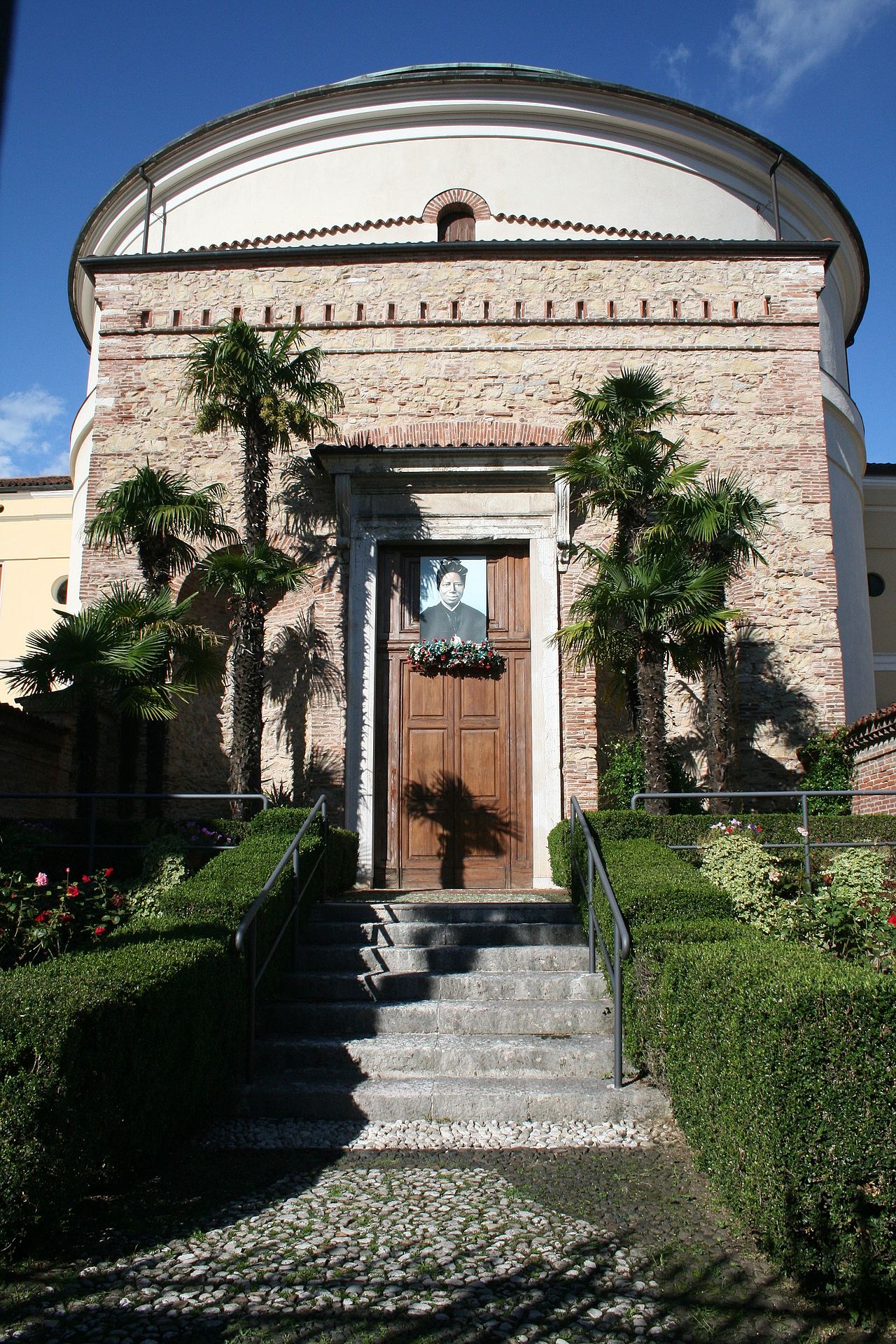
Anthony died here, in the Poor Clare monastery outside the walls, on June 13, 1231, having asked to be carried back into Padua and got no further. The monastery is gone. The church raised over the ground keeps the Cella del Transito, the small room tradition marks as the place of his death, with a seventeenth-century figure of the dying saint inside it.
Conventual Franciscan friars serve the sanctuary, which is also the parish church of the Arcella quarter, a little over two kilometres north of the basilica. Fewer pilgrims come here than to Il Santo; the cell is a place for quiet prayer. On June 13 the anniversary is kept here with its own observances.
🕯️ Annual Feast Days & Celebrations
Feast of Saint Anthony of Padua — June 13
The largest celebration in Padua, drawing hundreds of thousands of pilgrims for the "Tredicina" — thirteen days of preparation, ending in solemn Masses, processions through the historic centre, and all-night veneration at the tomb. On the evening of June 13 the relics are carried through the streets by candlelight.
Feast of the Translation of the Relics ("Feast of the Tongue") — February (Third Sunday after Candlemas)
The feast commemorates the discovery of Anthony's incorrupt tongue in 1263, when his body was moved into the new basilica. Solemn Masses and a procession of the relics inside the basilica mark the day.
🛏️ Where to Stay
Distances below are straight-line from the Basilica of Saint Anthony, which is where most pilgrim days in Padua begin; Santa Giustina lies 600 m south of it and the Scrovegni Chapel 1.2 km north, both an easy walk from any of these.
Hotel Casa del Pellegrino (hotel) — The pilgrim house of the Santo, 110 m from the basilica doors, with 140 rooms in an old baroque palace. Plain, practical, and the shortest walk to the tomb of any bed in the city. Website ∙ Reserve this hotel
Hotel Donatello ⭐⭐⭐ — On the piazza in front of the basilica, 110 m from it, in a building whose arcade faces the square and Donatello's bronze horseman. Website ∙ Reserve this hotel
Art Hotel Al Fagiano (hotel) — A small hotel 170 m from the basilica; its own site describes every room as personalised with colour, furnishings and original works of art. Website ∙ Reserve this hotel
Hotel Giotto ⭐⭐⭐ — 260 m from the basilica and a few steps from Prato della Valle, the great oval square where the Saturday market is held. Website ∙ Reserve this hotel
Casa Santa Caterina e Sant'Antonio (guesthouse) — 390 m from the basilica on the hospital side of the old town. The house keeps the name of the religious institute that founded it; it has been run by a company since 2020. Website ∙ Reserve this hotel
More hotels in Padua on Booking.com →
Accommodation available to book near Padua. Pilgrim houses and religious guesthouses are listed above — many take bookings directly and do not appear on booking sites.
🚗 Getting There
By Air: Venice Marco Polo Airport (VCE) lies about 45 kilometres from Padua, with direct BusItalia coaches to Padua's bus station (roughly 75 minutes). Treviso Airport (TSF) also has bus connections; Verona Airport (VRN) is about 90 kilometres west.
By Train: Padua sits on the main Milan–Venice line. High-speed Frecciarossa and Frecciargento services connect it to Venice (25 minutes), Bologna (1 hour), Milan and Florence (about 2 hours), and Rome (3 hours). Padova station is about 2 kilometres north of the Basilica of Saint Anthony.
By Car: From the A4 motorway (Milan–Venice), take the Padova Est exit and follow signs for Centro Città and Ospedale. From the A13 (Bologna–Padua), use Padova Sud. The historic centre has limited traffic zones (ZTL); garages include Prato della Valle and the hospital area near the basilicas.
Local Transport: Trams run from the train station through the centre, with the "Santo" stop serving the Basilica of Saint Anthony directly. Buses 3, 12 and 18 also connect the station to the pilgrimage sites. The historic centre is compact and easily walked.
📚 Further Reading
Books:
Vergilio Gamboso, OFM Conv., Life of St. Anthony: Assidua (Messenger Press) — The earliest biography of the saint, written within two years of his death.
Sophronius Clasen, OFM, St. Anthony: Doctor of the Church (Franciscan Herald Press) — A scholarly study of Anthony's theology and preaching.
Jack Wintz, OFM, Saint Anthony of Padua: His Life, Legends, and Popular Devotions (St. Anthony Messenger Press) — An accessible introduction for modern pilgrims.
Teresa Tomeo. Italy's Shrines and Wonders: Discovering Sacred Spaces, Fascinating Places, and Destinations off the Beaten Path — A shrine-by-shrine guide to Catholic Italy drawn from more than sixty journeys there, covering the major basilicas and the small places that rarely reach a guidebook.
Articles & Online Resources:
Official Basilica of Saint Anthony Website — Information on the basilica, its relics, and pilgrimage services.
Padova Urbs Picta UNESCO Site — The official site for Padua's fourteenth-century fresco cycles.
Scrovegni Chapel Booking and Information — Visitor information and reservations for Giotto's frescoes.
📿 Devotional Items
Anthony's tomb and incorrupt tongue rest at Il Santo, the most visited shrine in Italy outside Rome.
Ghirelli Rosary of Saint Anthony (Ghirelli) — Bohemian sapphire glass, 8 mm, hand-made in Italy.
Saint Anthony of Padua Medal with Cord (I G J) — Made in Italy, the saint holding the Child.
Saint Anthony of Padua Statue, 6 inch (Vittoria Collection) — White sculpture, made in Italy.
🔗 Useful Links
Basilica di Sant'Antonio di Padova — Official site with Mass times, pilgrimage information, and virtual tours.
Turismo Padova — Official tourism portal with practical visitor information.
Scrovegni Chapel Reservations — Advance booking for Giotto's frescoes.
Abbey of Santa Giustina — Information on the basilica and its Benedictine community.
Santuario Antoniano dell'Arcella — The sanctuary at the site of Anthony's death.
Messenger of Saint Anthony — The monthly magazine published by the friars of the basilica.
🧭 Nearby Pilgrimage Destinations
Venice (36 km east) — St. Mark's Basilica, relics of the Evangelist, and historic churches across the lagoon city.
Verona (70 km west) — Cathedral complex and Basilica of San Zeno, a major Romanesque pilgrimage church.
Trento (95 km northwest) — Cathedral of the Council of Trent, where the Church's response to the Reformation was defined.
Bologna (112 km southwest) — Basilica of San Domenico with the tomb of St. Dominic, and the Sanctuary of the Madonna di San Luca.
🪶 Closing Reflection
"If you preach Jesus, he will melt hardened hearts; if you invoke him he will soften harsh temptations; if you think of him he will enlighten your mind; if you read of him he will satisfy your intellect."
— St. Anthony of Padua, Sermones, quoted by Pope Benedict XVI, General Audience, 10 February 2010