
Behind the altar of a brick chapel on Troy Hill lie the complete skeletal remains of a saint named Demetrius, each bone wrapped in silk and set with imitation gems. Around him, floor to ceiling on every wall of the nave, some eight hundred hand-carved walnut cases hold better than five thousand relics — a thorn from the Crown of Thorns, the skulls of martyrs, slivers of the True Cross, and a molar of St. Anthony of Padua, for whom the chapel is named.
Troy Hill is one of the bluffs the Allegheny River cut into Pittsburgh's North Side, and reaching it is a climb. Rialto Street runs up through a ravine from Route 28 at the water to the plateau at the top, at a grade of twenty-four or twenty-five percent — the fifth steepest street in the city. What waits above is a neighborhood of narrow row houses built by German Catholic immigrants, a parish church at the corner of Claim and Harpster streets, and eighty meters uphill from it across a shared lot, the twin-spired chapel one of their pastors paid for himself to hold what he had carried home from Europe.
Father Suitbert Mollinger gathered the relics on repeated journeys through Belgium, the Netherlands, Italy and the German states, in the years when the Kulturkampf and Italian unification were dissolving monasteries and scattering their treasuries. Relics cannot be sold; they were handed to him for safekeeping, and he made donations in return. Almost all of them arrived with ecclesiastical certificates of authentication, the oldest dated August 12, 1716. Once a relic is sealed into its reliquary, the case is not opened.
📜 History & Spiritual Significance
Most Holy Name of Jesus parish was established in 1868 for the German Catholics of Troy Hill, and on July 4 of that year Bishop Michael Domenec appointed Suitbert Godfrey Mollinger its first pastor. He had been ordained in April 1859 by Bishop Joshua Maria Young of Erie. His birth is recorded two ways — April 19, 1828 at Kampenhout in the Kingdom of the Netherlands, by modern archival research; May 29, 1830 at Mechelen in Belgium, by the parish's own Latin register. The fuller biography the parish inherited, with its medical studies in Naples, Rome and Genoa and a father at the head of the Dutch government, found no documentary support when the historian Katherine Lukaszewicz went looking in 2023. What the documents carry is the chapel.
Mollinger had an inheritance, and he spent it on relics. By 1880 the diocesan historian Father Andrew Lambing counted perhaps four thousand of them arranged in a room Mollinger had prepared at the rectory, and called the collection one of the largest and rarest in America. Two years later Mollinger began building somewhere to put them. Work on the first chapel started on June 13, 1882, the feast of St. Anthony of Padua, and the building was dedicated a year to the day later, on June 13, 1883. That first structure forms the core of what stands now, from the sanctuary to the central arch. Some accounts, including the shrine's own and the historical marker outside, date the project from 1880.
The crowds outgrew it. A nave was added, extending the chapel toward Harpster Street and filled with life-sized Stations of the Cross carved in Munich from linden wood and windows from the Zettler workshops. The enlarged chapel was rededicated on June 13, 1892. Mollinger died two days after that, on June 15, following surgery for a ruptured stomach, his recovery undone by the exhaustion of the feast; Smithsonian Magazine puts the crowd at the previous June's feast above fifteen thousand. He left no will. His heirs took what could be carried — the crystal chandeliers, a black onyx altar, the candelabra — and the parishioners of Most Holy Name bought the chapel and its remaining contents, Bishop Richard Phelan signing the mortgage on their behalf.
Mollinger was a priest who also practiced medicine, and from the mid-1880s the press followed the sick who came to Troy Hill for his treatment and for the blessing of the relics. Their crutches are kept in the museum across Harpster Street, among his belongings.
By the 1970s the chapel had fallen into disrepair. A parish restoration committee formed in 1972 with the approval of Bishop Vincent Leonard; work began in April 1974, paid for by donations — the Troy Hill resident Mary Wohleber sold the roof's slates one at a time to raise them — and the chapel reopened in November 1977 with a Mass of thanksgiving. The Pittsburgh History & Landmarks Foundation had designated it a landmark in 1968, and the City of Pittsburgh listed it as a historic structure on February 22, 1977, under the name Shrine of St. Anthony of Padua. In 2019 the Diocese of Pittsburgh grouped it with four other churches — St. Patrick and St. Stanislaus Kostka in the Strip District, Immaculate Heart of Mary in Polish Hill, and St. Nicholas in Millvale — as the Shrines of Pittsburgh.
☩ Pilgrimage Sites in Pittsburgh
Saint Anthony Chapel
The walls of the nave are the collection: glazed walnut cases from the wainscot to the cornice, each labelled in Latin, some eight hundred of them. Beneath the altar lies the skeleton of St. Demetrius. Under a side altar to the right of the triumphal arch is the molar of St. Anthony of Padua that the shrine describes as the only principal relic of its patron kept outside Padua. There are the skulls of Macharius and Stephana, of companions of St. Ursula, of a Theodore; relics of every saint named in the Roman Canon; and a monstrance-form reliquary made in Aachen in 1880 by August Witte, holding a particle of the True Cross among many other relics, which is carried out to bless the faithful at the novena. A fragment of the table of the Last Supper is sealed inside the mensa of the high altar and is not on view. Life-sized Stations of the Cross, carved in Munich from linden wood, line the nave beneath the Zettler glass. Outside, a copper St. Anthony stands on the gable between the two spires, and a museum in a house across Harpster Street holds Fr. Mollinger's belongings.
The shrine's claim to hold the largest collection of relics for public veneration outside the Vatican is repeated by Smithsonian Magazine and the National Catholic Register. It has been questioned: Katherine Lukaszewicz has proposed the relic treasury of the Escorial in Spain as the larger holding, and the figure of five thousand is the chapel's own count rather than an audited one.
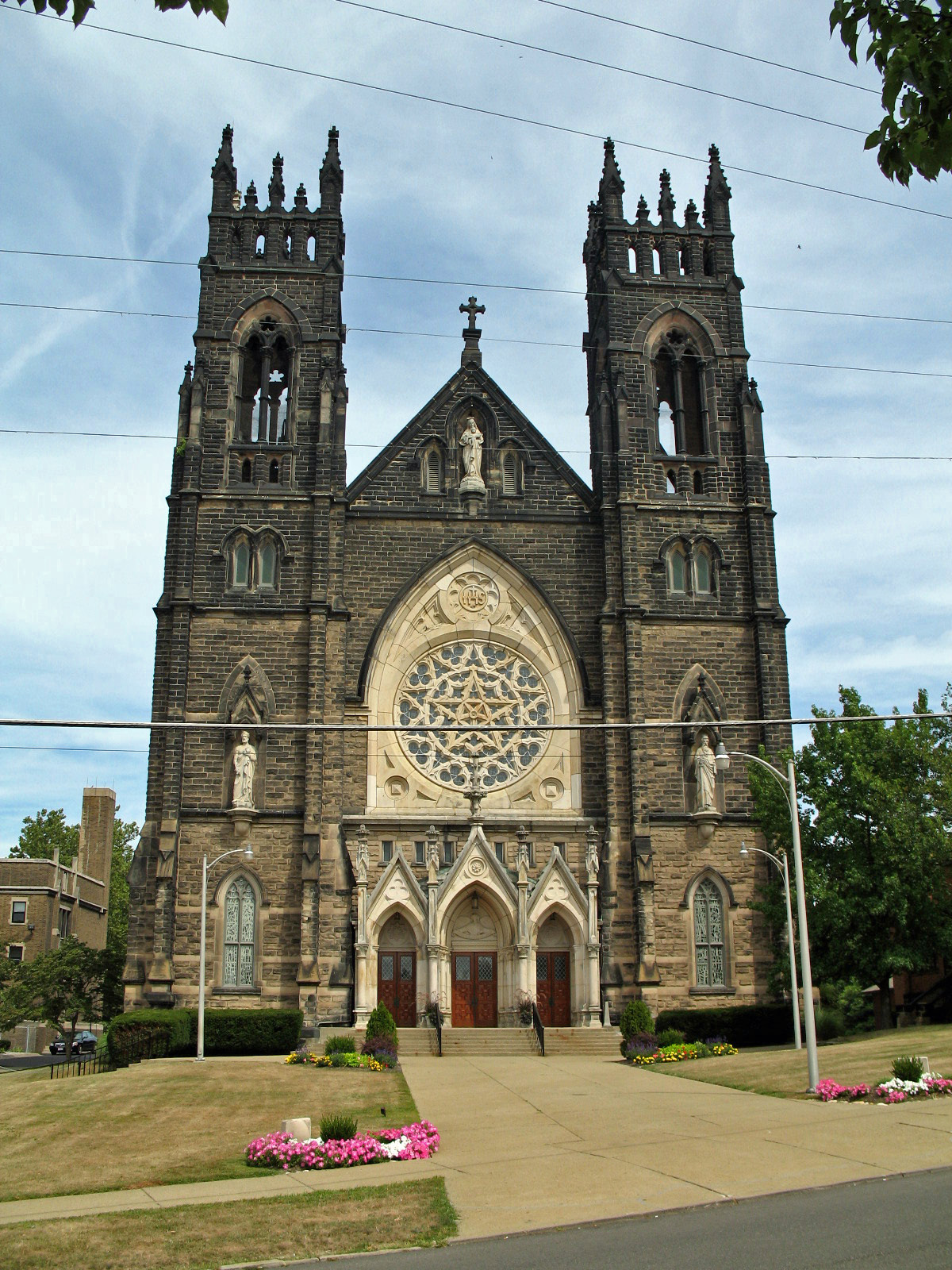
Most Holy Name of Jesus Church
The parish church Mollinger was sent to in 1868, built by the German Catholics of Troy Hill at the corner of Claim and Harpster streets. It sits eighty meters downhill from the chapel and shares its lot and its parking; a pilgrim parks between the two and walks up. The chapel was built beside it, and the parish bought the chapel back after its founder's death.
🕯️ Annual Feast Days & Celebrations
Feast of St. Anthony of Padua — June 13
The chapel's patronal feast, and the date it was dedicated in 1883 and rededicated in 1892. The shrine keeps the day with Mass in the morning and in the evening, the St. Anthony Novena, docents in the chapel through the afternoon, and a dinner in honor of the saint in the Most Holy Name school hall, taken by reservation. Recent programs have added a healing service in the late morning, an echo of Mollinger's ministry to the sick; it appears in some years' programs rather than as a fixed part of the day. The novena prayed each Tuesday through the year reaches its solemn form on this evening.
Stations of the Cross in Lent
Through Lent the chapel prays the Stations before its life-sized linden-wood carvings, on Sunday afternoons and on a weekday evening. Catholic organizations from around the diocese arrange group Lenten pilgrimages to Troy Hill, which the shrine hosts; those are not fixed dates in its own calendar.
🛏️ Where to Stay
The shrine operates no guesthouse. Pilgrims stay in Pittsburgh and travel up to Troy Hill for the visit.
The Priory Hotel (boutique hotel) — Forty-two rooms in a Benedictine monastery built in 1888 and restored as a hotel in 1986, on the North Side in Deutschtown. It stands on the same bank of the Allegheny as Troy Hill, a few minutes away by car. Website
TRYP by Wyndham Pittsburgh/Lawrenceville (hotel) — A 108-room hotel at the foot of the 40th Street Bridge in Lawrenceville, which faces Troy Hill across the river; the closest branded hotel to the chapel by road. Website ∙ Reserve this hotel
More hotels in Pittsburgh on Booking.com →
Accommodation available to book near Pittsburgh. Pilgrim houses and religious guesthouses are listed above — many take bookings directly and do not appear on booking sites.
🚗 Getting There
By Air: Pittsburgh International Airport (PIT) is the region's gateway, about 22 km (14 miles) west of Troy Hill in a straight line.
By Train: Amtrak's Pennsylvanian (New York–Philadelphia–Harrisburg–Pittsburgh) and Capitol Limited (Washington–Chicago) call at Union Station, 1100 Liberty Avenue, about 2.4 km south of the chapel across the Allegheny.
By Bus: Pittsburgh Regional Transit route 4, signed Troy Hill, connects downtown Pittsburgh at 9th Street and Penn Avenue with the hill.
By Car: Route 28 runs along the Allegheny below the bluff, and Rialto Street climbs from it through the ravine to the plateau — a grade of twenty-four or twenty-five percent, the fifth steepest street in Pittsburgh. The chapel and Most Holy Name share a parking lot off Harpster Street.
📚 Further Reading
Books:
Marion Amberg. Monuments, Marvels, and Miracles: A Traveler's Guide to Catholic America — A state-by-state survey of Catholic America, Pennsylvania included, built around relics, small chapels and miracle shrines; the companion for a pilgrim planning more of the region.
Charles Warren Stoddard. St. Anthony: The Wonder-Worker of Padua — The classic English life of the chapel's patron, a nineteenth-century text reprinted by TAN Books; background for the saint whose tooth the shrine keeps.
Online Resources:
How One Priest Brought More Than 5,000 Relics to Pittsburgh — The National Catholic Register on Mollinger's acquisitions, the authentication documents, and how the relics are venerated.
Smithsonian Magazine on the relics of Saint Anthony Chapel — A visit to the chapel, its collection and its founder, with the nineteenth-century crowd reports.
Shrine of St. Anthony — historical marker — The Pittsburgh History & Landmarks Foundation marker at the chapel, transcribed with photographs.
🎥 Recommended Videos
Saint Anthony Chapel — The shrine's own film, walking the chapel interior and its reliquary cases.
Saint Anthony Chapel, Pittsburgh with Father Aron Maghsoudi — A nine-minute tour with the chapel's priest, produced by the Diocese of Altoona-Johnstown.
THAT'S A LOT - ST. ANTHONY CHAPEL — WQED Pittsburgh, the city's PBS station, on the scale of the relic collection.
🔗 Useful Links
Saint Anthony Chapel — Shrines of Pittsburgh — The shrine's own page, with visitor guidance and its account of the chapel's history.
Shrines of Pittsburgh — The five diocesan shrines the chapel belongs to, for a pilgrim planning a circuit of the city.
Diocese of Pittsburgh — Diocesan website, with the parish directory covering Most Holy Name of Jesus.
🧭 Nearby Pilgrimage Destinations
Steubenville (55 km west) — The Portiuncula Chapel at Franciscan University, a stone replica of St. Francis's oratory in Assisi and a Vatican-designated site of plenary indulgence.
Emmitsburg (242 km east-southeast) — The National Shrine of St. Elizabeth Ann Seton, the first American-born saint, in the Maryland town where she founded the first free Catholic school for girls in 1809.
Carey (292 km west-northwest) — The Basilica and National Shrine of Our Lady of Consolation, rooted in the 1875 "Miracle of the Rain" procession of German Catholic settlers.
Washington, D.C. (307 km east-southeast) — The Basilica of the National Shrine of the Immaculate Conception and the Catholic quarter of the Brookland ridge around it.
Baltimore (315 km east-southeast) — America's first Catholic diocese, erected in 1789, and the basilica from which the Church in the United States was organized.
🪶 Closing Reflection
"He is one of the most popular Saints in the whole Catholic Church, venerated not only in Padua, where a splendid Basilica has been built that contains his mortal remains, but also throughout the world."
— Pope Benedict XVI, General Audience on St. Anthony of Padua, 10 February 2010



.jpg)
