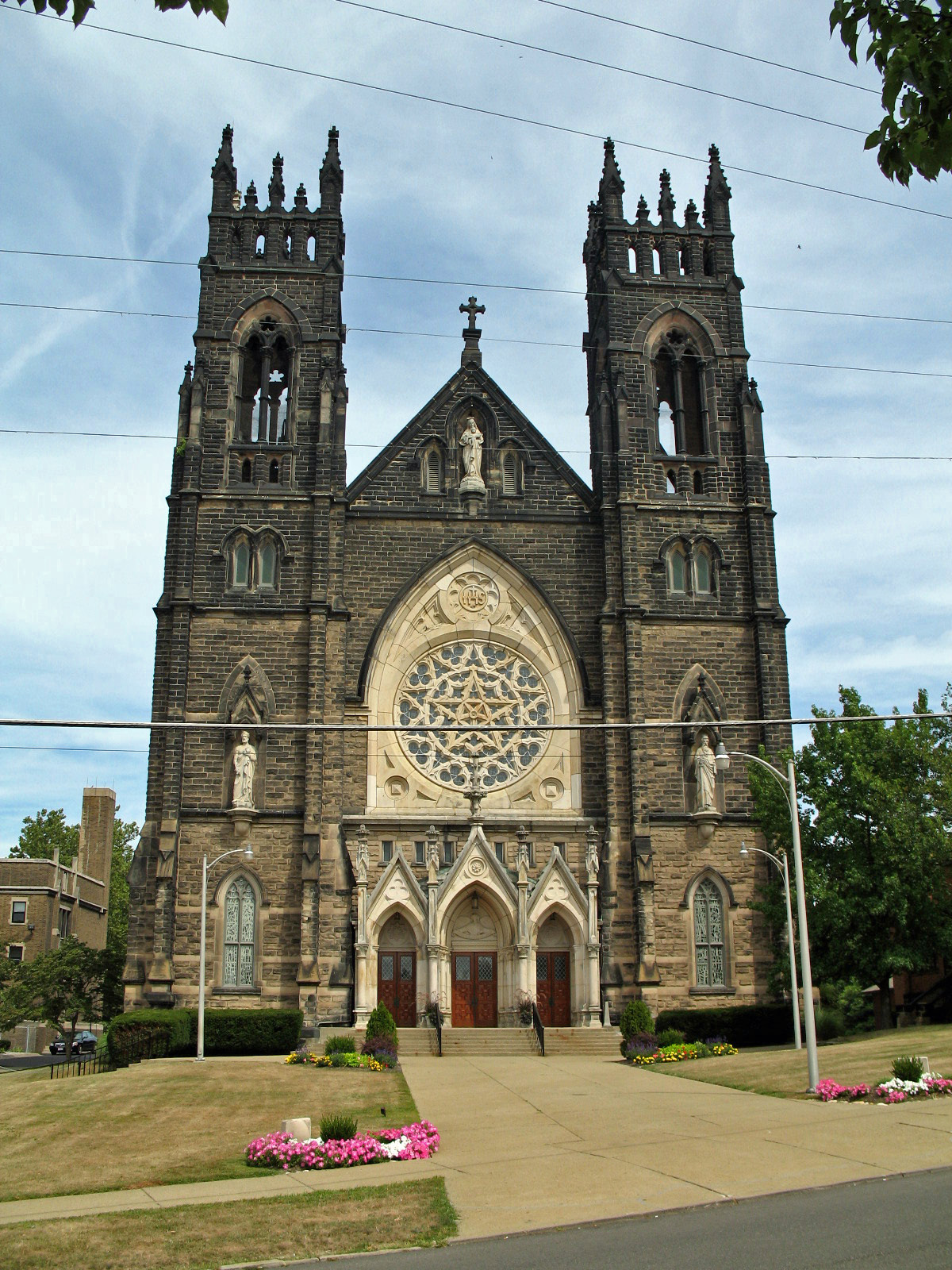
On July 26, 1701 — two days after Antoine de la Mothe Cadillac landed on the straits of the Detroit River and began raising the palisades of Fort Pontchartrain — the two Recollet priests who had accompanied the expedition dedicated a small log chapel on the riverbank to Saint Anne, grandmother of Christ and patron of New France. The date was not accidental: July 26 is the feast of Saint Anne, and Cadillac understood that a settlement in the wilderness required not only walls but an altar. That chapel has been rebuilt eight times in the centuries since, moving across the city as Detroit grew, but the parish register has been maintained without interruption since 1704. More than three centuries later, the Basilica of Sainte Anne de Détroit still stands in the southwest quarter of the city, its neo-Gothic towers rising above the rooftops near the Ambassador Bridge, keeping an unbroken thread of Catholic life running back to the age of French exploration.
Detroit's Catholic geography reflects the layered history of a city built by French colonists, settled by German and Irish immigrants, industrialized by Henry Ford, devastated by white flight and urban decline, and now — in parts — quietly renewed. The German parish of St. Joseph, founded in 1855 near Eastern Market, anchors one end of that story: its 200-foot Victorian Gothic steeple, which was the tallest structure in Detroit when it was completed in 1892, still pierces the skyline of the city's central east side. The Cathedral of the Most Blessed Sacrament, a Norman Gothic edifice of Ohio sandstone on Woodward Avenue, represents the institutional weight of the Archdiocese established in 1833. And in a Capuchin monastery on Mount Elliott Street, the tomb of Blessed Solanus Casey receives more than 100,000 visitors a year from pilgrims who come to pray at the resting place of the friar who spent decades at the porter's window of St. Bonaventure Monastery, listening to the sick and the struggling, and interceding with a faith that left behind a documented trail of healings.
The 2025 Jubilee Year of Hope designated twelve Detroit-area sites as official pilgrimage destinations, among them St. Joseph Shrine, the Basilica of Ste. Anne, the Cathedral, and the Solanus Casey Center. Archbishop Allen Vigneron's pastoral letter on pilgrimage drew on the words of Pope Francis's bull Spes Non Confundit — "hope does not disappoint" — and invited the faithful of southeastern Michigan to make their own journey through a city whose Catholic roots are among the deepest in the United States.
📜 History & Spiritual Significance
The Diocese of Detroit was erected in 1833, carved out of the vast Diocese of Cincinnati which had encompassed the entire Old Northwest Territory. The first bishop, Frédéric Résé, found a diocese of scattered French Canadian settlements, a few Irish immigrant communities, and a thin network of mission stations reaching into the Michigan wilderness. The Catholic population was small, the finances precarious, and the churches primitive. Within two decades, however, the completion of the Erie Canal in 1825 had transformed Detroit from a frontier outpost into an industrial entrepôt, and successive waves of German, Irish, Polish, Italian, and Hungarian immigrants had built the parish network that still defines the city's religious geography.
The German Catholics who arrived in the 1840s and 1850s were perhaps the most energetic builders. By 1855, the German-speaking community on Detroit's east side had established St. Joseph Parish, worshipping first in a modest frame church before commissioning the Victorian Gothic structure that stands today. The architect they chose was Francis Georg Himpler (1833–1916), a Saarland-born designer based in New York who had trained in the tradition of Gothic Revival ecclesiastical architecture. Himpler laid the cornerstone in 1870 and completed the church in 1873; the 200-foot spire followed in 1892. For a brief period, St. Joseph's steeple was the tallest structure in Detroit. The interior Himpler created was dense with carved woodwork, decorative ironwork, and stained glass produced primarily by the Detroit firm of Friedericks and Staffin — the forerunner of the Detroit Stained Glass Works, which would operate in the city until 1970. The National Register of Historic Places listed St. Joseph Church in 1972, citing it as one of the finest examples of Victorian Gothic architecture in the Midwest.
The twentieth century brought decline to the parish as the German community dispersed to the suburbs and the east side of Detroit depopulated. By 2016, St. Joseph's was attached to Mother of Divine Mercy Parish and functioning as a chapel rather than a full community. That year, Archbishop Vigneron invited the Institute of Christ the King Sovereign Priest — a clerical society founded in 1990 in France by Canon Gilles Wach and Canon Philippe Mora, devoted to the traditional Latin Mass — to take responsibility for the building and reconstitute it as a personal parish dedicated exclusively to the extraordinary form of the Roman Rite. The revival was rapid: the congregation quadrupled within a few years, drawing Latin Mass communities from across the metropolitan region and from considerable distances beyond. In March 2020, Vigneron elevated the church to the status of archdiocesan shrine, formally recognizing its liturgical life, artistic heritage, and musical program.
The French thread of Detroit Catholicism runs even deeper. Sainte Anne de Détroit, dedicated by Recollet missionaries in 1701, is the second-oldest continuously operating Catholic parish in the United States — second only to St. Augustine in Florida, founded in 1565. The parish endured the Seven Years' War, the transfer of sovereignty from France to Britain in 1760, and two devastating fires that destroyed its buildings. It survived the American Revolution and then the transition to American rule after 1796. The present Gothic Revival building on St. Anne Street was completed in 1886. On March 1, 2020, Pope Francis elevated the church to the status of minor basilica — the eighty-sixth in the United States and only the third in Michigan. The relics of North American missionaries are preserved within, and the basilica holds the oldest stained glass in the city.
Blessed Solanus Casey (1870–1957) was born Bernard Francis Casey in Oak Center, Wisconsin, the sixth of sixteen children of Irish immigrant parents. After a peripatetic early career — he worked as a prison guard, streetcar conductor, and laborer before discerning a religious vocation — Casey was ordained in 1904 as a Capuchin Franciscan with the condition that he could not preach doctrinal sermons or hear confessions, his academic preparation having been judged insufficient by his German-speaking seminary. For more than four decades, Casey served as porter at Capuchin monasteries in New York and Detroit, greeting visitors at the door, writing in voluminous notebooks about his prayer life, and acquiring a reputation for prophetic insight and healing. When he was stationed at St. Bonaventure Monastery in Detroit from 1945, the lines of people seeking his counsel stretched down the street. He died on July 31, 1957, at the age of 86. Pope Francis beatified him on November 18, 2017, at a ceremony attended by tens of thousands at Ford Field.
☩ Pilgrimage Sites in Detroit
St. Joseph Shrine
The sole parish in the Archdiocese of Detroit dedicated exclusively to the celebration of Mass according to the 1962 Roman Missal, St. Joseph Shrine is the most visually arresting Catholic building on Detroit's east side. Francis Georg Himpler's Victorian Gothic composition rises from the corner of Jay and Sheridan Streets with a confidence that the surrounding neighborhood — a mix of empty lots, Eastern Market warehouses, and modest residential blocks — has never diminished. The 200-foot stone spire, completed in 1892, was for a time the highest point in the city. Inside, the nave displays the carved woodwork, elaborate ironwork screens, and painted surfaces characteristic of German Catholic interior design in the late nineteenth century; the stained glass produced by Friedericks and Staffin fills the lancet windows with figures and scenes whose detail rewards close examination. The archdiocesan designation as a shrine in 2020 recognized not only the architecture but the living liturgical tradition: every Mass at St. Joseph is in the extraordinary form, the choir sings polyphony and Gregorian chant, and the parish has attracted an active community of young families, students, and converts drawn to the traditional rite. The shrine was designated one of twelve official Jubilee Year 2025 pilgrimage sites in the Archdiocese of Detroit.
Basilica of Sainte Anne de Détroit
Basilique Sainte-Anne de Détroit
Founded on July 26, 1701, two days after Cadillac's landing, Sainte Anne de Détroit holds a place in American Catholic history matched only by the missions of the Spanish Southwest. The parish survived the loss of its earliest records in fire, maintaining a continuous registry from 1704 — the oldest in the Great Lakes region. The present building, completed in 1886 under the direction of the architectural firm of Leon Coquard, is a Gothic Revival structure of brick and stone that recalls the churches of French Canada: tall nave, pointed arches, prominent towers, stained glass in every window. The basilica contains the relics of martyred North American missionaries including Blessed Jacques Gravier, a Jesuit who worked among the Illinois people and died of wounds inflicted during an attack in 1708. Pope Francis elevated the church to the status of minor basilica on March 1, 2020 — the eighty-sixth minor basilica in the United States. A $30 million restoration of the building and grounds was announced in 2025, ensuring that the oldest continuously operating parish community in Michigan will be materially preserved for another generation.
Cathedral of the Most Blessed Sacrament
The seat of the Archdiocese of Detroit occupies a prominent position on Woodward Avenue in the New Center district, its Norman Gothic mass of Ohio sandstone and Indiana limestone presenting a severe dignity appropriate to the primary church of a major American diocese. Bishop John Samuel Foley established Most Blessed Sacrament Parish in 1905; construction of the present cathedral began that year but proceeded in stages, the building not being dedicated until 1930 and the towers and facade not completed until 1951. The architect was Henry A. Walsh of Cleveland, who designed the church in a Norman Gothic idiom — a deliberate choice that distinguished the building from the pointed English Gothic of many American cathedrals. The interior was substantially redesigned in the 1980s and 1990s by architect Gunnar Birkerts, a modification that has attracted both admiration and criticism. Pope John Paul II visited the cathedral on September 19, 1987, during his second pastoral journey to the United States. The cathedral was designated one of the twelve official Jubilee Year 2025 pilgrimage sites in the Archdiocese.
Solanus Casey Center
Blessed Solanus Casey spent the last twelve years of his life at St. Bonaventure Monastery in the McDougall-Hunt neighborhood on Detroit's east side, and it is there — within the complex now called the Solanus Casey Center — that his remains are enshrined. The center, dedicated in 2002 by Cardinal Adam Maida, houses a museum tracing Casey's life from his Wisconsin childhood through his decades as a Capuchin porter in New York and Detroit, a chapel for private prayer and liturgy, a gift shop, and a café and bakery. The adjacent Capuchin Soup Kitchen, which Casey helped found in 1929 during the Great Depression, continues to serve more than one thousand meals a day. Pilgrims come to pray at the tomb for healing, guidance, and the intercession of a man whose beatification cause the Church formally opened in 1983 and Pope Francis ratified with beatification on November 18, 2017. The Solanus Casey Center was designated one of the twelve official Jubilee Year 2025 pilgrimage sites in the Archdiocese of Detroit.
🕯️ Annual Feast Days & Celebrations
Feast of St. Joseph — March 19
The primary annual celebration at St. Joseph Shrine culminates on the feast of its patron. In the days preceding March 19, the parish observes a solemn nine-day novena with themed homilies each evening. On the feast day itself, a Solemn High Mass in the extraordinary form is sung by the canons of the Institute of Christ the King, followed by a procession through the streets of Eastern Market carrying the shrine's statue of Saint Joseph. The Shrine also marks the 150th anniversary of the completion of the Himpler building — a milestone celebrated in 2023 with special observances and a conference on the spirituality of Saint Joseph. The church's extraordinary form liturgy, polyphonic choir, and incense-filled nave make the March 19 celebration one of the most formally elaborate traditional-rite Masses regularly offered in the United States.
Feast of Saint Anne — July 26
The Basilica of Sainte Anne de Détroit observes the feast of its patron — July 26, the anniversary of the original 1701 dedication — with a solemn Mass and procession that recalls the founding of the parish and the mission of the Church in New France. The celebration draws pilgrims from across the metropolitan area and from the French Canadian communities of Ontario, for whom Sainte Anne holds a devotion reaching back to the habitant settlements of the St. Lawrence Valley. The feast is also an occasion for the basilica community to renew its connection to the broader history of Catholicism in the Great Lakes region.
Feast of Blessed Solanus Casey — July 30
The Capuchin Franciscan community at the Solanus Casey Center celebrates the feast of Blessed Solanus on July 30, the liturgical date assigned following his beatification. A solemn Mass and prayer service at the tomb draw pilgrims seeking Casey's intercession, and the celebration is typically attended by members of the Capuchin Province of St. Joseph, which has stewarded Casey's cause for canonization. On November 18 — the anniversary of the 2017 beatification at Ford Field — the center also hosts a commemorative Mass drawing pilgrims who wish to mark the day of his official elevation to the rank of Blessed.
🛏️ Where to Stay
Shinola Hotel ⭐⭐⭐⭐ — A luxury property in the heart of downtown Detroit, occupying a complex of restored historic buildings and celebrating the craftsmanship associated with the Shinola brand. Well situated for visiting both St. Joseph Shrine and the Solanus Casey Center on the east side, and the Cathedral and Ste. Anne on the west. Website ∙ Reserve this hotel
Cambria Hotel Detroit Downtown ⭐⭐⭐⭐ — Located in the Albert Kahn-designed former WWJ radio station building at 600 West Lafayette Boulevard, the Cambria places guests within easy reach of all four major pilgrimage sites. The building's architectural pedigree is appropriate to a city shaped by industrial design. Website ∙ Reserve this hotel
The Siren Hotel (boutique hotel) — Occupying the historic Wurlitzer Building in downtown Detroit, The Siren is a carefully restored property with 106 rooms, ground-floor food and retail tenants, and a design aesthetic drawn from the city's musical and manufacturing heritage. Website ∙ Reserve this hotel
Atheneum Suite Hotel ⭐⭐⭐ — Detroit's only all-suite hotel, located in the Greektown district within walking distance of downtown. The 174-suite property occupies a postmodern building and offers skyline views and marble bathrooms. Convenient access to I-75 makes it practical for visiting sites across the city. Website ∙ Reserve this hotel
More hotels in Detroit on Booking.com →
Accommodation available to book near Detroit. Pilgrim houses and religious guesthouses are listed above — many take bookings directly and do not appear on booking sites.
🚗 Getting There
By Air: Detroit Metropolitan Wayne County Airport (DTW) is the primary international gateway, located approximately 27 km southwest of downtown Detroit in Romulus. The airport is served by all major US carriers and numerous international airlines. From DTW, the Detroit Air Xpress (DAX) shuttle operates sixteen daily round-trips to downtown Detroit.
By Train: Amtrak serves Detroit Station at 11 West Baltimore Avenue in the New Center district, the departure point for the Wolverine route connecting Detroit to Chicago (approximately five hours) via Dearborn, Ann Arbor, Battle Creek, and Kalamazoo. Three round-trips daily. From the station, the QLine streetcar connects New Center to Midtown and Downtown.
By Car: Detroit lies at the intersection of several major interstate highways. I-75 (Chrysler/Fisher Freeway) and I-94 (Ford Freeway) provide access from the north, south, and east; I-96 connects to Grand Rapids and western Michigan; I-275 links to Toledo and Ohio to the south. Downtown parking is widely available in surface lots and structures. The pilgrimage sites are distributed across the city, and a car is the most practical means of moving efficiently between them.
By Bus: Greyhound and FlixBus serve Detroit from Chicago, Cleveland, Toledo, and other regional cities, arriving at the Detroit Transportation Center. SMART regional buses and the Detroit Department of Transportation (DDOT) local network provide urban connections, though coverage and frequency vary by neighborhood.
By International Ferry: The Detroit-Windsor Tunnel and Ambassador Bridge connect Detroit to Windsor, Ontario. Windsor is accessible by transit from Canadian cities, making cross-border pilgrimage practical for visitors from Toronto and southwestern Ontario.
📚 Further Reading
Books:
Roman Godzak. Catholic Churches of Detroit — A photographic survey of Detroit's Catholic built heritage from the colonial log chapel to twentieth-century suburban construction. Over 200 photographs, many previously unpublished.
Kevin Schmiesing and Mike Aquilina. A Catholic Pilgrimage through American History — A wide-angle survey of American Catholic history through the lens of place, including the frontier missions of the Old Northwest Territory from which Detroit's diocese emerged. Third-place winner of the Catholic Media Association award for pilgrimages and Catholic travel.
Christopher Shannon. American Pilgrimage: A Historical Journey through Catholic Life in a New World — A scholarly narrative of the American Church from colonial evangelization through the late twentieth century, drawing on current historiography to situate Detroit's story within the broader arc of Catholicism in the United States.
Online Resources:
St. Joseph Shrine — Historic Detroit — Architectural history, archival photographs, and documentation of the Himpler building from Detroit's principal historic preservation organization.
Liturgical Arts Journal: St. Joseph Shrine, a Victorian Gothic Masterpiece — A detailed architectural and liturgical appraisal of the shrine's interior and its 150-year tradition.
Archdiocese of Detroit: Jubilee Pilgrimage Sites — The official archdiocesan page for the 2025 Jubilee Year of Hope, with information on all twelve designated pilgrimage sites in southeastern Michigan.
Parish History — Sainte Anne de Detroit — The official history of the oldest Catholic parish community in Michigan, from the 1701 founding through the 2020 basilica elevation.
🎥 Recommended Videos
At St. Joseph Shrine, Foster Father of Jesus Is a Vibrant Presence — Detroit Catholic video feature on the shrine's liturgical life and its remarkable growth under the Institute of Christ the King Sovereign Priest since 2016.
🔗 Useful Links
St. Joseph Shrine — Institute of Christ the King Sovereign Priest — Official parish website with liturgical schedule, pilgrimage information, and news from the community.
Basilica of Sainte Anne de Détroit — Official website of the second-oldest continuously operating Catholic parish in the United States, with history, visitor information, and the basilica's restoration project.
Cathedral of the Most Blessed Sacrament — Archdiocesan cathedral website with tour information, history, and archdiocesan resources.
Solanus Casey Center — Official site of the pilgrimage center housing the tomb of Blessed Solanus Casey, with information on visiting, the museum, and the Capuchin Soup Kitchen.
Archdiocese of Detroit — Shrines — Directory of all recognized shrines in the Archdiocese of Detroit.
🥾 Pilgrim Routes
Journey with the Saints — Detroit Saint Walk — An organized walking pilgrimage through downtown Detroit visiting historic Catholic sites, including SS. Peter and Paul Jesuit Church (built 1846, the oldest place of Christian worship in the city) and Sacred Heart Major Seminary. The route connects several sites on the Detroit Catholic heritage trail. Information at detroitsaintwalk.net.
Monroe to Detroit Walking Pilgrimage — An annual June pilgrimage on foot from Monroe, Michigan, to Detroit, tracing the corridor of the old French River Raisin settlements northward to the city. The route passes through communities with deep French Canadian Catholic roots and arrives at sites in downtown and east Detroit.
🧭 Nearby Pilgrimage Destinations
Orchard Lake, Michigan (40 km northwest) — The Shrine of St. John Paul II at Orchard Lake Schools, a complex of Polish Catholic institutions founded in 1885, designated a Jubilee Year 2025 pilgrimage site by Archbishop Vigneron.
National Shrine of the Little Flower Basilica, Royal Oak, Michigan (24 km north) — The Basilica of the National Shrine of the Little Flower, built by the controversial radio priest Father Charles Coughlin in 1931, dedicated to St. Thérèse of Lisieux and designated a minor basilica.
Holy Hill, Wisconsin (480 km northwest) — The National Shrine of Mary Help of Christians atop a prominent hill in Hubertus, Wisconsin, one of the most visited Marian shrines in the Midwest.
Toledo, Ohio (90 km south) — Our Lady, Queen of the Most Holy Rosary Cathedral, built 1931, with extraordinary German-American Romanesque architecture and one of the finest collections of stained glass in the American Midwest.
Windsor, Ontario, Canada (across the river) — Assumption Parish in Windsor, Ontario, founded 1767, one of the oldest Catholic parishes in Canada, directly across the Detroit River from downtown.
🪶 Closing Reflection
"A pilgrimage on foot is a great aid for rediscovering the value of silence, effort and simplicity of life."
— Pope Francis, Spes Non Confundit, Bull of Indiction for the Jubilee Year 2025, May 9, 2024

.jpg)