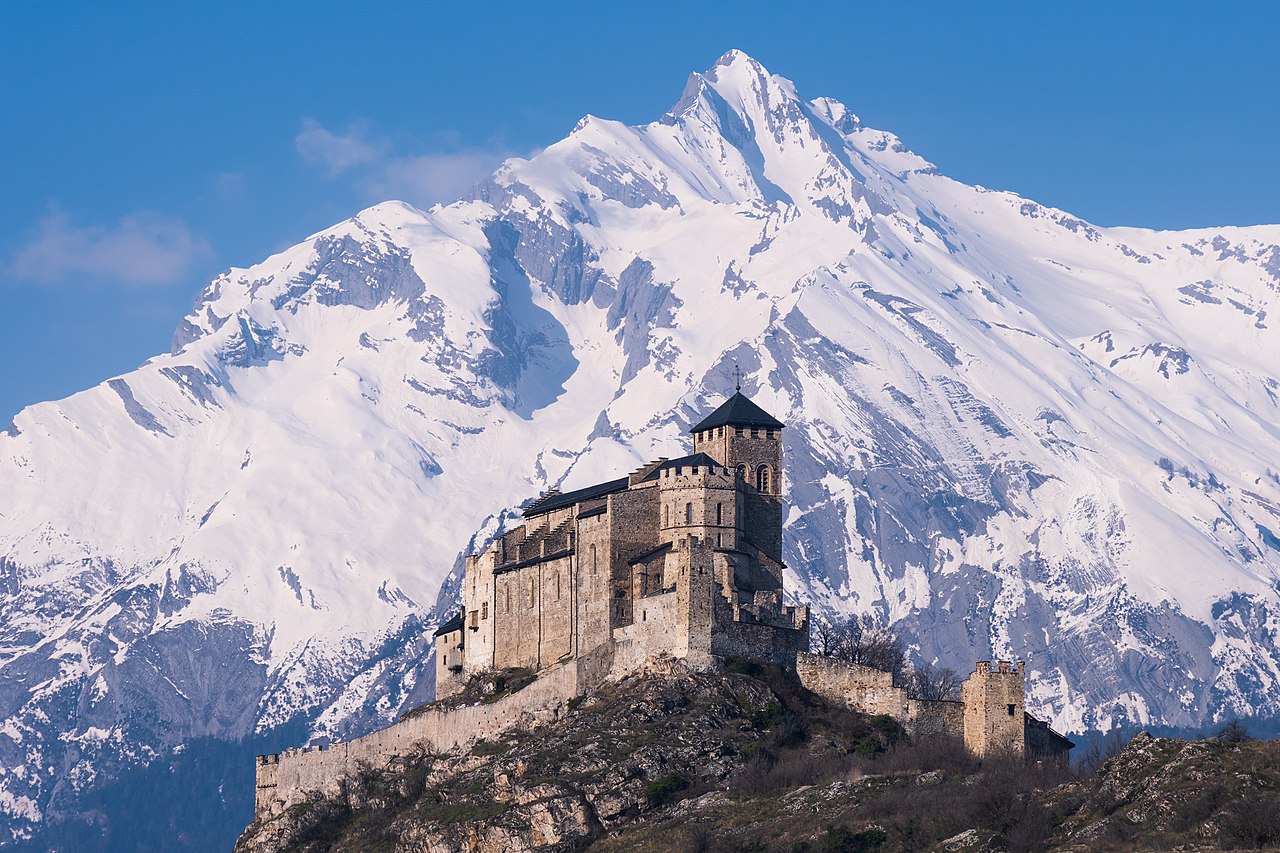
The road out of Sion's old town climbs between two rock hills, and where the tarmac gives out every visitor goes on by foot. On the higher hill stand the open, roofless walls of Tourbillon, the castle the prince-bishops lost to fire in May 1788 and never rebuilt. On the lower one stands a church that has never been a ruin: Notre-Dame de Valère, begun by the canons of Sion in the twelfth century, finished in Gothic by the middle of the thirteenth, and holding since then an interior that almost nowhere else in Europe has kept — a thirteenth-century jubé, or rood screen, standing where it was built, and above the west end an organ of about 1435 that is played at Mass.
Two things are true of this hill at once, and a pilgrim is better served knowing both before the climb. Valère is a minor basilica, raised to that rank by Pope John Paul II in 1987, and one of only two places the Diocese of Sion names as places of pilgrimage within its own territory — the other is the hermitage of Longeborgne, in the gorges east of the town. The cathedral chapter prays here. But the walled village around the church has been the Valais History Museum since 1883, and most people who come up the hill come as visitors to a monument: there is a ticket office, there are museum opening hours, and the choir where the liturgy is celebrated cannot be entered on an ordinary visit, only on a guided tour. Entry to the nave itself is free.
That mixture is not a modern accident. It is what a thousand years of continuous use looks like when almost nothing has been destroyed — and the reason nothing was destroyed is a change in the wind.
📜 History & Spiritual Significance
The diocese did not begin at Sion. It was founded downstream at Octodurum, the Roman town now called Martigny, and the bishops moved their seat up the Rhône valley to Sion when the rivers made Octodurum untenable; the diocese dates that move to the end of the fifth century. What followed made Sion unusual. In the late tenth century Rudolph III, last king of Upper Burgundy, granted the County of Valais to Bishop Hugo, and from then the bishops of Sion held temporal as well as spiritual power. They were prince-bishops, and they built accordingly: the bishop on Tourbillon, the cathedral of Notre-Dame du Glarier in the town below, and on the middle hill the canons of the cathedral chapter — founded in 1043 — in a walled town of their own.
The name Valère appears in writing in 1049, already as the chapter's seat. The canons built their church there through the twelfth century and into the thirteenth, beginning in the Romanesque manner and finishing in the Gothic; the nave was widened and given its two aisles between 1235 and 1267. After that the shape of the building barely changed again. What changed was what went into it. The murals and the organ arrived around 1435. A marble Madonna with the child was set above the high altar in the fifteenth century. The canons' stalls in the choir are Baroque, of the mid-seventeenth. Around 1800 the canons came down off the hill to live beside the cathedral, and Valère was left to keep what it already had.
It kept it because of a wind. In May 1788 fire took the town of Sion and gutted Tourbillon, which was never rebuilt. The wind carried the flames away from the Valère hill, and the church, its furniture and its organ came through untouched — a deliverance the organist Edmond Voeffray names as the reason the instrument survives at all. The steepness of the approach did the rest: Valère was awkward to reach in the revolutionary years when churches elsewhere were being stripped, and awkwardness protected it.
The Roman title came late and was asked for from below. In June 1987 Bishop Henri Schwery petitioned the Holy See for the church to be honoured with the title of minor basilica, "echoing", as the papal document put it, "the common desires of the people and the clergy". The Apostolic Brief was signed by Cardinal Agostino Casaroli, Secretary of State; in it John Paul II — who had prayed at Valère himself during his pastoral visit to the diocese in June 1984 — described the church on the hill as "the witness not only of the Christian faith but also of the great veneration the faithful have devoted here to the Blessed Virgin Mary from the twelfth century to our own day". Sion had hoped the brief would arrive in time for the third Sunday of October, which is the feast of the dedication of Valère. It reached the town on the Saturday evening. At the Mass on Sunday 18 October 1987, with the Apostolic Nuncio Mgr Edoardo Rovida and Bishop Schwery in the sanctuary, the dean of the chapter read it aloud. The nuncio took the trouble to explain to the congregation that "minor" was not a slight: the major basilicas are the four great churches of Rome and no others, and a church that becomes a basilica ceases to be only a diocesan church and takes on a universal standing. Among the objects kept in the basilica's Treasury today is a chalice given by John Paul II at the end of the twentieth century.
Prayer on the hill is not a memory. The diocese describes Valère as un sanctuaire habité par la prière et l'histoire — a sanctuary inhabited by prayer and by history — and a living place of worship where pilgrimages, vigils, Masses and periods of silence gather the faithful each year. In the Holy Year of 2025 the diocese named two jubilee places, the cathedral in the town and the basilica on the hill, and on the evening of Sunday 23 November 2025 more than four hundred people walked between them by torchlight, keeping a time of Taizé prayer in the basilica at the top. Bishop Jean-Marie Lovey preached on the shape of the climb itself: "In the mountains, when the storm rises, you must go down to find shelter. In the same way, on pilgrimage, you must go down into your own heart in order to rise towards God."
☩ Pilgrimage Sites in Sion
Basilica of Our Lady of Valère
Basilique Notre-Dame de Valère
The church stands at the top of the lower of the two rock hills above Sion, walled about by the little town the cathedral canons built for themselves. What they left when they came down to the town has scarcely been touched since. Over the high altar stands a Gothic marble Madonna with the Child, of the fifteenth century. Across the church runs one of the last thirteenth-century rood screens in Europe — the wall that divides the choir of the canons from the nave of the people. The painted murals date from about 1435, and so does the organ on the west wall, built by an unknown hand and reckoned the oldest playable organ in the world; its pipes are set out to draw the rough shape of a church, two towers and a roof. In the old archive room against the west end is kept the Treasury of the basilica: late-medieval reliquary purses, a fragment of an eleventh-century Near Eastern dalmatic, and a chalice given by Pope John Paul II. The altar and its furnishings were remade at the beginning of this century, and the museum that holds the site says plainly what that means — the basilica demeure un lieu de prière vivant, remains a living place of prayer.
A pilgrim should know how the hill is entered. Valère is run as a monument, not as a shrine with an open door: the nave is free to enter, but only during the opening hours of the Valais History Museum, which occupies the canons' old houses inside the same walls. The choir, the Treasury and the organ cannot be seen on a free visit — each is reached by a booked guided visit, and the Treasury is opened only in that way, for the sake of its conservation. Hours and booking: see the museum's own page. Religious ceremonies take place here alongside the visits.
The higher hill facing Valère carries the ruin of Tourbillon, and the two are read together. Valère was the church's house — the chapter, the choir, the prayer; Tourbillon was the prince-bishop's own castle, begun by Boniface de Challant at the end of the thirteenth century, when the bishops of Sion held temporal power as well as spiritual. Since the fire it has been a fine open ruin, and the choir of its chapel keeps a cycle of murals from the start of the fourteenth century, but it is a monument and not a place of prayer; the pilgrim who climbs it climbs for the view and the history.
Chapel of All Saints
Chapelle de Tous-les-Saints
Halfway up the path from the town, where the road between the two hills begins to climb, a small chapel of bare stone stands against the rock. It was founded in 1325 and restored in 1964. The walls are Romanesque in manner, in the way of the older churches of the Valais; a square bell tower rises on the north side with two tiers of twin-arched windows under a stone spire, and the porch beneath is Gothic — a later door set into an older building. It is a place to stop and breathe on the climb, a hundred metres below the basilica.
Cathedral of Our Lady of Glarier
Cathédrale Notre-Dame du Glarier
The cathedral stands in the old town, some four hundred and fifty metres west of the hill of Valère, and it is the mother church of the Valais: the seat of the bishop and, at the same time, an ordinary parish. It belongs to the same venerable Chapter whose canons built Valère above. The Romanesque bell-porch at the west front is the oldest surviving part of the building, raised at the end of the twelfth century or the beginning of the thirteenth; over its round-arched door is a painted tympanum — the Virgin and Child on a red ground, two bishops beside her, the donors kneeling on blue — painted at the end of the fourteenth century or the start of the fifteenth. The church behind it is mostly of the later fifteenth and early sixteenth centuries, Gothic, on the foundations of two earlier churches. Inside stands the triptych of the Tree of Jesse, which was kept at Valère for centuries and brought down in 1947 by Bishop Victor Bieler for his rebuilt cathedral: the vine springs from the sleeping Jesse's side, the Virgin stands on the crescent moon, and on the right-hand panel is St Théodule, bishop of Octodurum and patron of the diocese of Sion. Mass times: see the parish's own page.
🕯️ Annual Feast Days & Celebrations
Valère keeps no great pilgrimage day of the kind that empties a valley — no patronal weekend of tens of thousands, no torchlit procession fixed in the calendar. What it keeps is the round of the cathedral chapter, which has prayed on this hill for close to a thousand years and owns it. The diocese describes the year here as pilgrimages, vigils, Masses and times of silence rather than as a date, and the Society of the Friends of Valère says that Masses are celebrated in the basilica regularly through the year. What neither the diocese nor the society prints is a schedule of them, so a pilgrim arriving on an ordinary day cannot know in advance whether a Mass will be offered. The fixed points below are the ones a pilgrim can plan a climb around.
The Dedication of Valère — Third Sunday of October
The anniversary of the church's dedication is the basilica's own feast and the nearest thing the hill has to a principal day. It has fallen on the third Sunday of October since at least 1987, when the town hoped the Apostolic Brief raising Valère to a minor basilica would reach Sion in time for it — the brief arrived on the Saturday evening and was read aloud at the dedication Mass the next morning. The day opens with Mass in the basilica, and the Society of the Friends of Valère keeps its own celebration on it: themed visits into corners of the hill that are otherwise closed, and, after the liturgy, an apéritif offered by the Venerable Chapter of the Cathedral of Sion. Of all the year's Masses on the hill, this is the one to choose if only one climb is possible.
The Assumption — August 15
The Assumption is kept in the basilica, and it is one of the days on which the organ of about 1435 accompanies the Mass — a fifteenth-century instrument sounding a Marian feast in the church it was built for. The high summer date puts it in the middle of the museum season, so the hill is busy with visitors as well as worshippers; come early for the liturgy rather than late for the crowd.
Mass of the Friends of Valère — a Sunday in June
Once a year, on a Sunday in June, the Society of the Friends of Valère gathers for Mass in the basilica, usually preceded by a guided visit in the town or the museum and followed by a shared apéritif on the hill. It is an association's day rather than a diocesan pilgrimage, and it is named here because it is one of the few occasions when the basilica is used as a church by a gathered congregation rather than walked through by ticket-holders. Passing pilgrims have been welcomed to the table.
Beyond these, the Friends of Valère publish each year the list of Masses at which the ancient organ is played: it takes in Easter Day, the Ascension, the Assumption, the Dedication and the feast of Christ the King, along with scattered Sundays from March through to Advent. The list, and the Chapter's current Mass schedule, are the places to check before travelling, since times change from year to year. Friends of Valère — the year's organ Masses
🛏️ Where to Stay
Sion is a small cantonal capital, and the pilgrim sites sit close together: the cathedral stands in the town below, and the climb to Valère begins at the top of the old town. A room anywhere in the centre puts both within a short walk. There is no pilgrim guesthouse here — the diocesan house Notre-Dame du Silence holds the diocesan offices and a student residence rather than guest rooms, and the diocese's one house that lodges visitors, the maison St Jodern, is away in Visp in the Upper Valais.
Hotel Castel ⭐⭐⭐ — Quiet house on the east side of town directly under the two castle hills, about 300 metres from the basilica in a straight line; the hotel puts the walk from its own door up to Valère and Tourbillon at roughly twenty minutes, according to pace. Twenty-six rooms, all with a view of the mountains or the castles, and a large sun terrace. Website ∙ Reserve this hotel
Hôtel Elite ⭐⭐⭐ — In the middle of town on the Avenue du Midi, a five-minute walk from the railway and postal stations and some 370 metres from the cathedral, with the old town and the path to the hill beyond it. The straightforward choice for a pilgrim arriving by train. Website ∙ Reserve this hotel
Bed and Bath Valère (B&B) — Bed and breakfast on the Rue du Rhône in the centre, the closest of these houses to both the cathedral (about 290 metres) and the foot of the basilica hill (about 300 metres). Listed by the Sion tourist board; rooms are arranged with the house itself rather than through a booking site. Website
ibis Sion ⭐⭐⭐ — On the Avenue du Grand-Champsec at the eastern edge of town beside the A9 motorway, about 1.4 kilometres from Valère and well outside comfortable walking distance of the old town. The plain choice for a pilgrim arriving by car. Website ∙ Reserve this hotel
More hotels in Sion on Booking.com →
Accommodation available to book near Sion. Pilgrim houses and religious guesthouses are listed above — many take bookings directly and do not appear on booking sites.
🚗 Getting There
By Air: Geneva Airport (GVA) is the natural gateway for pilgrims arriving from outside Switzerland — about 160 km west of Sion by road, and better still by rail, since the airport has its own railway station and half-hourly InterRegio trains run from it up the Rhône valley to Sion without a change. Zurich Airport (ZRH) is the other option, roughly 290 km away, and needs a change of train on the way.
By Train: Sion lies on the Simplon line, the main artery of the Valais, 92.4 km from Lausanne. SBB runs the InterRegio services IR 90 and IR 95 half-hourly between Geneva Airport and Brig, both calling at Sion; four EuroCity trains a day link Genève-Cornavin with Milano Centrale through the Simplon tunnel, one of them continuing to Venice, so pilgrims coming from northern Italy have a direct road in. RegionAlps works the local trains between Monthey and Brig. Sion station stands at the southern edge of the old town: the walk up to the old town takes about twenty minutes, and the hill of Valère is some 815 metres from the platforms in a straight line — but the ground rises, and the museum that keeps the site counts twenty-five minutes on foot from the station to the gate.
By Bus: The nearest stop to the hill is Sion, Nord, at the bottom of the Rue des Châteaux. Both the town's own Bus Sédunois network — run by PostBus on the municipality's behalf since 1998 — and the regional PostBus routes towards Savièse, Anzère, Ayent and Crans-Montana call there. Line numbers on this network have been changed in recent years; take the current ones from the operator's own timetable rather than from a guidebook.
By Car: Leave the A9 motorway at the exit Sion-Est and follow signs for the parking de la Cible or the parking du Nord, both at the foot of the two hills; the Planta and Scex car parks serve the town centre. Do not plan to drive further. Motor traffic is forbidden in the old town beneath the castles, and no road climbs to the basilica.
On Foot: The way up is the Rue des Châteaux, which leaves the old town and climbs between Valère and Tourbillon. From the old town the walk takes at least ten minutes, and carries the pilgrim through the wall of the little chapter town to the basilica door. The Chapel of All Saints stands about halfway, a good place to stop.
Local Transport: This is the fact that shapes a visit to Valère: the last stretch can only be done on foot. No shuttle, no funicular and no service road brings a visitor to the church; the streets are cobbled and the final approach is a flight of steps. A taxi may drive as far as the Place Maurice-Zermatten, at the foot of the two hills, which spares the walk up from the station or the car park but not the climb itself. The cathedral of Notre-Dame du Glarier, in the level streets of the town below, is reached without any climb at all.
📚 Further Reading
Books:
Fr. Johannes Maria Schwarz. Via Alpina Sacra: The Longest Pilgrimage across the Alps — Travel diary of the 4,300 km walk an Austrian priest made across the eight Alpine countries in 2018, visiting more than 200 shrines, monasteries and chapels between Aquileia and the Lérins islands.
Kev Reynolds. Walking in the Valais — Cicerone's walking guide to the canton, 120 routes and treks; a practical companion for the pilgrim who reaches Valère and Longeborgne on foot rather than by road.
Online Resources:
Valère Basilica — Wikipedia article on the church, its Romanesque-Gothic fabric and its 1430s organ, with references to the scholarly literature.
🎥 Recommended Videos
Valère Basilique Restaurée — The Swiss Catholic portal cath.ch walks through the basilica after the 2017–2022 restoration of the choir and nave, guided by the canton's conservator of historic monuments. Filmed before the inauguration Mass of 12 June 2022. In French.
Joel Pralong Valere — Abbé Joël Pralong on his ministry at Notre-Dame de Valère: the chaplaincy below the church, where he receives whoever pushes the door open, faithful and passers-by alike. cath.ch, 2022. In French.
Le Trésor de Valère: un travail pour l'éternité — Valais regional television Canal9 on the treasury of the basilica and the conservation work behind it. In French.
🔗 Useful Links
Diocese of Sion — Valère and Longeborgne — The diocese's own page on making a pilgrimage in the Valais, which names the hill of Valère and the hermitage of Longeborgne as its two places of pilgrimage and describes the basilica as a sanctuary where the Chapter's prayer continues. In French.
Amis de Valère — The society formed around the basilica, whose home page carries the dated list of Masses celebrated at Valère to the old organ through the year, and names the Venerable Cathedral Chapter as the owner of the hill. The nearest thing to the Chapter's own voice on the web. In French.
Valais History Museum — practical information — Opening hours, admission and access for the whole walled site, with the basilica set out separately from the museum. Since the church is entered only during the museum's hours, this is the page that decides whether a pilgrim will find the door open; it also states plainly how hard the cobbles and stairs are for anyone with reduced mobility.
Basilique de Valère — travaux de restauration — The canton of Valais's own heritage dossier on the building, published by its property and heritage service: eight pages on how the church was built and how it has been repaired. A PDF, in French.
🥾 Pilgrim Routes
Pilgerweg Rhein-Reuss-Rhône — The Valais pilgrim way, 241 km in thirteen stages from the abbey of Disentis in Graubünden to the abbey of Saint-Maurice, crossing the Oberalp and Furka passes and then descending the Rhône the length of the canton. Sion closes the tenth stage: an easy 10.33 km from St. Léonard, about three hours, climbing 309 m and dropping 295 m, which crosses the Rhône and turns up the Bramois gorge past the hermitage of Longeborgne before entering the city under the hill of Valère. In the cathedral of Notre-Dame du Glarier, at the foot of that hill, St James the Greater stands in the left side altar. The eleventh stage leaves for Saillon, 22.55 km in about six hours and twenty minutes, on the waymarked Chemin du Vignoble No. 36 through the vineyards.
The way opened in July 2018 and links the Swiss Via Jacobi in the east to the Via Francigena in the west. Existing Swiss hiking paths carry its additional pilgrim waymarks, and stamp stations along the route serve the pilgrim's passport issued by the umbrella association Jakobsweg Schweiz — Compostelle Suisse. It is walked from spring to autumn: the Oberalp pass at 2,050 m and the Furka at 2,430 m are shut by snow in winter.
🧭 Nearby Pilgrimage Destinations
Ermitage de Longeborgne (3.6 km east) — The other of the two places the Diocese of Sion names as sites of pilgrimage in its own territory, and the one Valaisans have loved longest: a Marian hermitage set in the gorge above Bramois, its chapels cut into the living rock, its walls hung with ex-votos, a hermit in permanent residence. For more than five hundred years people have climbed the steep paths here to lay their intentions, their griefs and their hopes before Our Lady of Compassion and St. Anthony of Padua. The way up from Bramois is short and stiff — about 2.7 km on the round, an hour on foot, with a Way of the Cross leading to the monastery gate.
Saint-Maurice (28 km west; 43 km by road) — The two places are one journey. Both stand in the canton of Valais, on the same floor of the Rhône valley and on the same railway: the hourly InterRegio between Geneva Airport and Brig and the half-hourly regional train between Monthey and Brig call at each station, so a pilgrim rides from one to the other without changing trains. What waits at the far end is the opposite of Valère, and that is the reason to go. The abbey of Saint-Maurice was founded in 515 over the graves of the Theban martyrs and has never once stood empty since; the Canons Regular of St. Augustine keep the office there, some twenty-seven of them. On the hill above Sion the canons also built a walled town and sang in choir, from 1043 until about 1800 — and then they went down to the cathedral and left the place to its silence. Valère shows a pilgrim what such a life leaves behind; Saint-Maurice shows what it looks like kept rather than left. The abbey stands, too, on the Via Francigena, on the stretch walked from Lausanne toward the Great St. Bernard Pass, which is why the pilgrim bound for Rome commonly meets it first.
Domodossola (73 km east) — A UNESCO-listed Sacro Monte of fifteen Stations chapels, on the mountain where Blessed Antonio Rosmini founded his Institute of Charity in 1828.
Oropa (83 km south-east) — Alpine sanctuary at 1,159 metres in the Biellese Alps, home to a Black Madonna venerated since the fourth century and crowned every hundred years since 1620.
Varallo Sesia (83 km south-east) — The oldest of the Sacri Monti, founded in 1491 as a New Jerusalem for pilgrims who could not reach the Holy Land.
🪶 Closing Reflection
"Au pied de cette colline de Valère dominée par l'antique cathédrale dédiée à Notre-Dame, au cœur de la vallée du Rhône. Au milieu de leur rude vie de montagnards, les Valaisans ont su garder vivante leur foi catholique et leurs traditions chrétiennes, en communion avec l'Evêque de Rome, Successeur de Pierre, qui est si heureux de visiter aujourd'hui la cathédrale actuelle, mais surtout cette maison spirituelle faite de pierres vivantes qu'est l'Eglise à Sion."
"At the foot of this hill of Valère, dominated by the ancient cathedral dedicated to Our Lady, at the heart of the Rhône valley. In the midst of their hard mountain life, the people of Valais have kept alive their Catholic faith and their Christian traditions, in communion with the Bishop of Rome, Successor of Peter, who is so happy to visit today the present cathedral — but above all that spiritual house made of living stones which is the Church at Sion."


