On Christmas Day in the year 496, in the ancient city of the Remi tribe, a Frankish king named Clovis knelt before Bishop Remigius to receive the waters of baptism. According to legend, a white dove descended from heaven bearing a small vial of sacred oil for the anointing. With this single act, witnessed by three thousand Frankish warriors who followed their king into the faith, Christian France was born. The successors of Clovis returned to this same city to receive their crowns, anointed with oil from that miraculous Sainte Ampoule, until the last coronation in 1825.
Reims stands as the spiritual birthplace of Catholic France and the coronation city of its kings. The soaring Gothic cathedral that dominates the skyline today rose in the thirteenth century, but its foundations rest upon far older sacred ground. Here Saint Remigius established his episcopal see, here the monarchs of France received divine sanction for their rule, and here Joan of Arc led the hesitant Dauphin Charles VII to claim his throne in 1429. Though German shells reduced much of the cathedral to ruins during the First World War, the people of Reims and benefactors from around the world restored this masterpiece of Gothic architecture to its former glory.
The city offers pilgrims a unique encounter with French Catholic heritage: the cathedral where angels smile in stone, the ancient basilica housing the relics of Saint Remigius, and the treasury palace preserving fragments of the Holy Ampulla itself. To walk through Reims is to trace the sacred history of a nation that once called itself the Eldest Daughter of the Church.
📜 History & Spiritual Significance
The story of Catholic Reims begins with Saint Remigius, born around 437 to a noble Gallo-Roman family. Consecrated Bishop of Reims at the remarkably young age of twenty-two, Remigius became the most influential churchman in Gaul during the tumultuous period of barbarian migrations. His episcopal tenure of over seven decades would transform not only his diocese but the entire future of Western Christianity.
The pivotal moment came when Clovis, pagan king of the Salian Franks, sought to consolidate his power over the remnants of Roman Gaul. His Christian wife Clotilde had long urged him to accept baptism. Following a decisive victory over the Alemanni at the Battle of Tolbiac in 496, Clovis fulfilled his promise to convert if his God granted him victory. On Christmas Day, Bishop Remigius performed the baptism in the cathedral of Reims, reportedly declaring, "Bow your head in meekness, Sicamber; adore what you have burnt and burn what you have adored."
The legend of the Holy Ampulla, first recorded by Archbishop Hincmar in the ninth century, held that a dove had descended from heaven bearing a vial of sacred chrism for Clovis's anointing. This miraculous oil, believed to be inexhaustible, became central to the coronation ritual of French kings. The chrism was preserved in the Abbey of Saint-Remi and brought to the cathedral for each coronation, reinforcing Reims's unique role as the sacral capital of France.
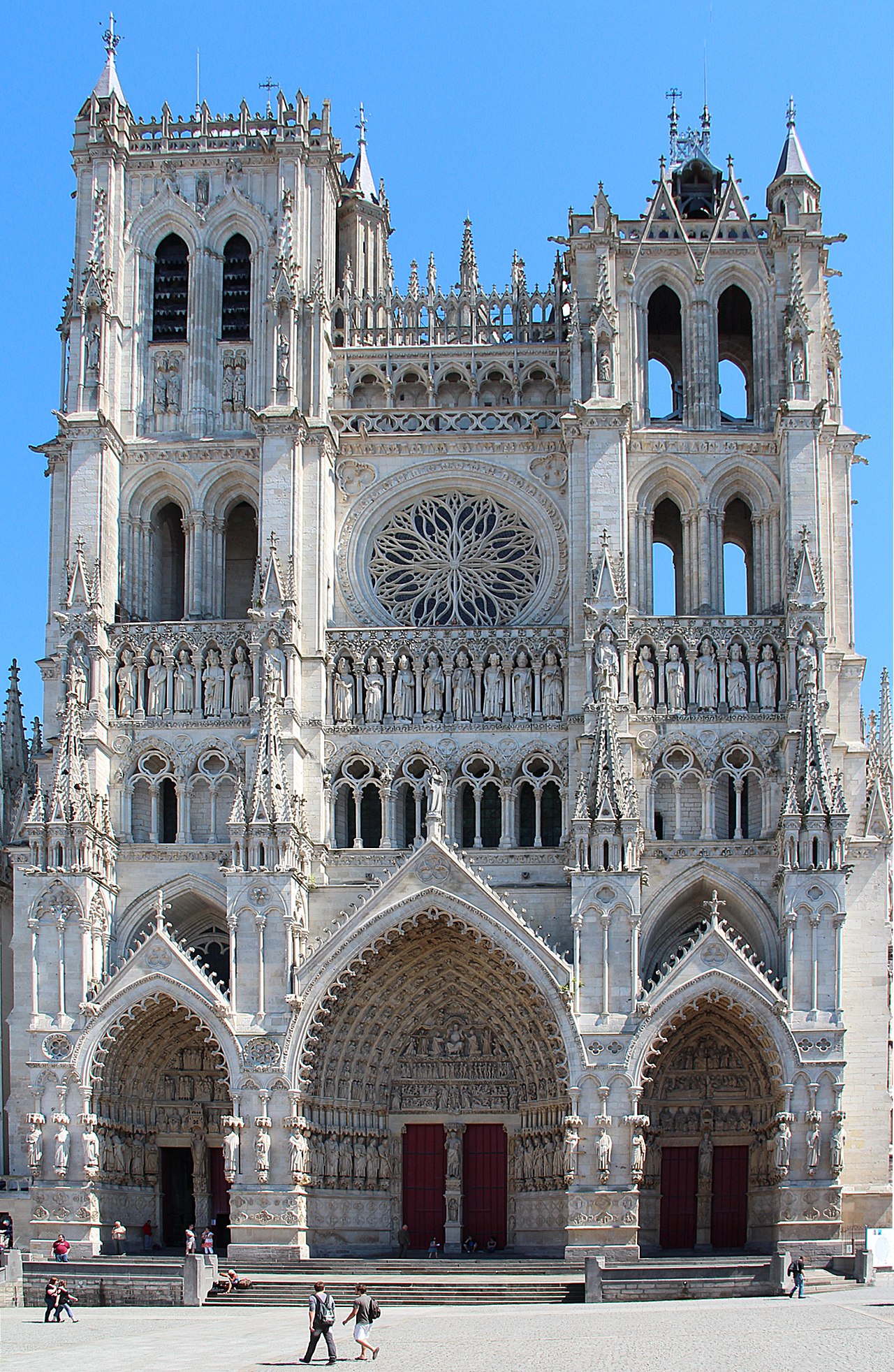
The Gothic cathedral visitors see today was begun in 1211 after fire destroyed its Carolingian predecessor. The new edifice took over a century to complete, with work continuing until the early fourteenth century. Master builders including Jean d'Orbais, Jean-le-Loup, Gaucher de Reims, and Bernard de Soissons created what many consider the most harmonious Gothic cathedral in France. The west facade alone displays over two thousand statues, including the famous L'Ange au Sourire, the Smiling Angel. Its gentle expression has been a favourite of visitors since the thirteenth century.
Between 1027 and 1825, twenty-nine kings of France were crowned at Reims Cathedral, from Henri I to Charles X. The most dramatic coronation occurred on July 17, 1429, when Joan of Arc led the Dauphin Charles VII through English-held territory to receive his crown. Standing near the altar with her banner, the peasant girl from Domremy witnessed the fulfillment of her divine mission. "Noble King," she declared, "now is executed the pleasure of God who wished I lift the siege of Orleans, and I bring you into this city of Reims to receive your holy coronation."
In October 1049 Pope Leo IX came to Reims to translate the relics of Saint Remigius and consecrate the rebuilt abbey church of Saint-Remi — an event witnessed, among others, by a young theology student from Cologne named Bruno, who had come to Reims to study and would head the episcopal school for nearly twenty years, from 1057 to 1075. Bruno would later refuse the Archbishopric of Reggio and withdraw to the wilderness of the Alps to found the Carthusian Order; yet from his hermitage in Calabria, near the end of his life, he wrote to his old friend Raoul le Verd, provost of the cathedral chapter of Reims, asking him to send a copy of the Life of Saint Remi, "because it is impossible to find a copy where we are." The founder of the strictest contemplative order the Latin Church has ever known kept, to the end, the devotion to the apostle of the Franks he had learned at Reims.
The French Revolution brought destruction to Reims's sacred heritage. In 1793, revolutionary Philippe Ruhl publicly smashed the Holy Ampulla on the pedestal of Louis XV's statue. Yet faithful Catholics had secretly preserved fragments of the vial and portions of the sacred oil, which were later reconstituted for the coronation of Charles X in 1825.
The cathedral suffered catastrophic damage during World War I. On September 19, 1914, German artillery shells struck the wooden scaffolding on the north tower, igniting a fire that consumed the roof, melted the bells, and caused molten lead to pour through the mouths of the gargoyles. The Smiling Angel was decapitated by falling debris, becoming an icon of French culture destroyed by war. International outrage followed, and after the armistice, reconstruction began with significant funding from American philanthropist John D. Rockefeller Jr. The restored cathedral was rededicated in 1938.
Today, Reims Cathedral, the Basilica of Saint-Remi, and the Palace of Tau together form a UNESCO World Heritage Site, recognized in 1991 for their outstanding universal value as monuments of Gothic art and as witnesses to the sacred history of France.
☩ Pilgrimage Sites in Reims
Cathedrale Notre-Dame de Reims
Cathedral of Our Lady of Reims
The coronation cathedral of the kings of France rises 81 meters above the city center, its twin towers visible for miles across the Champagne plain. This masterpiece of High Gothic architecture, begun in 1211, represents the culmination of French cathedral building, combining structural innovation with an unprecedented program of sculptural decoration.
The west facade presents one of the most elaborate sculptural ensembles in Christendom. Over 2,300 statues adorn the exterior, including the famous L'Ange au Sourire on the north portal, whose serene smile has survived German bombardment and decades of exposure to become the symbol of Reims. The central portal depicts the Coronation of the Virgin, while the Gallery of Kings above displays 56 statues of French monarchs, each over four meters tall.
Inside, the nave soars 38 meters to its vaulted ceiling, drawing the eye toward the great rose window above the main portal. The original thirteenth-century stained glass, depicting biblical scenes and the lives of saints, was largely destroyed in the First World War; some was restored, while artist Marc Chagall created new windows for the axial chapel in 1974, their vivid blues depicting the Tree of Jesse and scenes from the life of Christ.
The cathedral remains an active place of worship, with daily Mass and regular celebrations of the Divine Office. Pilgrims can venerate in the chapel of Saint-Joseph, which houses a fragment of the True Cross, and visit the ambulatory where French kings processed during their coronation.
Basilique Saint-Remi
Basilica of Saint Remigius
The oldest church in Reims predates the Gothic cathedral by two centuries and houses the relics of the apostle of the Franks. This former Benedictine abbey church, begun around 1005 under Abbot Aviard, combines Romanesque and early Gothic elements in a building of great antiquity and spiritual power.
The basilica was constructed to honor Saint Remigius, whose tomb had become a major pilgrimage destination following his death in 533. The saint's relics, enshrined here since 1099, rest in an elaborate nineteenth-century tomb in the choir, reconstructed after revolutionaries desecrated the original during the Terror. The reliquary contains the remains carefully preserved by faithful Catholics who hid them from destruction.
The interior displays magnificent Romanesque proportions with a nave of eleven bays leading to a Gothic choir rebuilt in the thirteenth century. Medieval pilgrims can be traced in the architectural modifications, as the transepts were lengthened in the late twelfth century to accommodate growing crowds of devotees. Surviving twelfth-century stained glass in the choir depicts saints and biblical scenes, while a grand organ by Christophe Cattiaux, inaugurated in 2000, fills the ancient space with music.
The adjacent museum, housed in the former abbey buildings, displays the history of the abbey and includes the Romanesque chapter house and cloister. The basilica's connection to royal coronations was essential, the ceremonies formally began and ended here, where the Holy Ampulla was kept between coronations.
Palais du Tau
Palace of Tau
The former residence of the archbishops of Reims, named for its T-shaped floor plan, served as the setting for royal coronation banquets from the tenth century until 1825. Today it houses the cathedral treasury and a remarkable collection of coronation regalia, tapestries, and original sculptures from the cathedral facade.
The palace was rebuilt in neoclassical style between 1671 and 1710, but its role in French sacred history extends back centuries earlier. Here princes spent the night before their coronations, and here they hosted sumptuous banquets afterward. The great hall where these celebrations took place, the Salle du Tau, can still be visited, its proportions suggesting the grandeur of medieval royal festivities.
Among the treasures on display, pilgrims can venerate the Holy Ampulla reliquary, which contains fragments of the original vial and traces of the sacred chrism used to anoint the kings of France. The Talisman of Charlemagne, a ninth-century reliquary pendant said to have belonged to the great emperor, represents one of the most precious objects in the collection. The museum also preserves original Gothic statuary removed from the cathedral for protection, including figures from the coronation portal and fragments of the Smiling Angel's damaged head.
The coronation tapestries depicting the life of Clovis and the history of the Holy Ampulla offer visual testimony to the sacred mythology that sustained French monarchy for over a millennium.
Chapelle Foujita
Foujita Chapel
This intimate twentieth-century chapel, designed and decorated by Japanese artist Tsuguharu Foujita following his conversion to Catholicism, represents a remarkable fusion of Eastern aesthetics and Christian devotion. Completed in 1966 and dedicated to Our Lady of the Vineyard, the chapel was built with support from Champagne house Mumm.
Foujita, baptized Leonard at Reims Cathedral in 1959, spent his final years creating the frescoes that cover the interior walls. His distinctive style, blending Japanese delicacy with Romanesque influences, depicts the life of Christ, the Virgin Mary, and scenes of the Apocalypse. The artist and his wife are buried in the chapel.
🕯️ Annual Feast Days & Celebrations
Feast of Saint Remigius — October 1
The principal feast of Reims's patron saint commemorates the translation of his relics and draws pilgrims to the basilica that bears his name. Special liturgies honor the apostle of the Franks, whose baptism of Clovis established the Christian identity of France. The Archbishop of Reims typically presides over solemn celebrations.
Johannine Festival — July
Each July, Reims commemorates the coronation of Charles VII on July 17, 1429, with festivities honoring Joan of Arc's role in leading the Dauphin to his crown. Historical reenactments, processions, and special Masses recall the Maid of Orleans and her mission to restore the French monarchy.
Assumption of the Blessed Virgin Mary — August 15
As the cathedral is dedicated to Our Lady, the Solemnity of the Assumption holds particular significance in Reims. This national holiday in France brings special liturgies and often processions through the cathedral close, honoring the patroness of the coronation church.
Christmas Season
The anniversary of Clovis's baptism on Christmas Day 496 gives special resonance to the Nativity celebrations in Reims. The cathedral hosts elaborate liturgies, and the connection between Christ's birth and the birth of Christian France infuses the season with historical meaning.
🛏️ Where to Stay
Distances below are measured from the cathedral of Notre-Dame, where the kings of France were crowned. The basilica of Saint-Remi, the city's other pilgrimage church, stands about 1.5 km to the south-east along the Voie des Sacres, and everything listed here lies between the two or north of the cathedral.
Hôtel & Spa La Caserne Chanzy ⭐⭐⭐⭐⭐ — 160 m, at 18 rue Tronsson Ducoudray, the nearest bed to the cathedral. The building is the Chanzy barracks, a former fire station opened in 1926, converted in 2019 with its Art Deco front kept. Website ∙ Reserve this hotel
Hôtel Gambetta (hotel) — 380 m, in the streets north of the cathedral. Reserve this hotel
Hôtel de la Cathédrale (hotel) — 400 m, in rue Libergier, on the axis that runs to the cathedral's west front. Reserve this hotel
Hôtel Le Bon Moine (hotel) — 420 m, in the city centre. Reserve this hotel
Hôtel des Arcades (hotel) — 460 m, in the city centre. Reserve this hotel
Best Western Premier Hôtel de la Paix (hotel) — 560 m, in rue Buirette. Reserve this hotel
Holiday Inn Reims Centre (hotel) — 700 m, near the convention centre; its restaurant on the seventh floor looks over the city to the cathedral. Reserve this hotel
Domaine Les Crayères (hotel) — 1.9 km, in a park on the south-east side of the city, on the way to the basilica of Saint-Remi. Reserve this hotel
More hotels in Reims on Booking.com →
Accommodation available to book near Reims. Pilgrim houses and religious guesthouses are listed above — many take bookings directly and do not appear on booking sites.
🚗 Getting There
By Air: Paris Charles de Gaulle Airport (CDG) is the nearest major international airport, located 130 km southwest of Reims. Direct TGV trains connect the airport station to Champagne-Ardenne TGV station in approximately 30 minutes, with connecting local trains to Reims Centre (12 minutes).
By Train: TGV high-speed trains from Paris Gare de l'Est reach Reims Centre station in 45 minutes, with 8-10 departures daily. The station is located 1 km northwest of the cathedral. Eurostar connections via Lille make Reims accessible from London in approximately 3 hours.
By Car: From Paris, take the A4 motorway (Autoroute de l'Est) directly to Reims, approximately 145 km and 90 minutes driving time. The cathedral quarter has limited parking; use the underground car parks at Boulingrin or Erlon. From Calais and the Channel ports, take the A26 south, approximately 200 km.
Local Transport: The city center is compact and walkable, with the cathedral, Palace of Tau, and main attractions within 500 meters. The Basilica of Saint-Remi is 1.5 km south; city buses connect the sites, or pilgrims can walk in approximately 20 minutes.
📚 Further Reading
Books:
Patrick Demouy, Notre-Dame de Reims: Sanctuaire de la monarchie sacree — The definitive historical study of the coronation cathedral by a leading French medieval historian. (CNRS Editions, 2001)
Donna L. Sadler, Reading the Reverse Facade of Reims Cathedral — Scholarly analysis of the sculptural program and its connections to royal ritual and ecclesiastical power. (Ashgate, 2012)
Meredith Parsons Lillich, The Gothic Stained Glass of Reims Cathedral — Groundbreaking study of the glazing program and its theological meanings. (Penn State Press, 2011)
Online Resources:
UNESCO World Heritage: Reims — Official documentation of the inscribed monuments and their outstanding universal value.
New Advent Catholic Encyclopedia: Saint Remigius — Detailed hagiographical entry on the apostle of the Franks.
Reims Cathedral Official Site — Visitor information, virtual tours, and history from the Centre des Monuments Nationaux.
🔗 Useful Links
Reims Tourism Office — Official visitor information including events, guided tours, and accommodation booking.
Archdiocese of Reims — Diocesan information including Mass schedules, sacramental information, and parish contacts.
Centre des Monuments Nationaux: Reims — Visitor information for the cathedral towers and Palace of Tau.
SNCF Connect — French national railway booking for TGV and regional train services.
Champagne Tourism — Regional tourism covering the UNESCO World Heritage Champagne sites.
🧭 Nearby Pilgrimage Destinations
Paris (145 km southwest) — The French capital's extraordinary concentration of sacred sites includes Notre-Dame Cathedral with the Crown of Thorns, the incorrupt body of Saint Catherine Laboure at the Miraculous Medal Chapel, and perpetual adoration at Sacre-Coeur.
Chartres (230 km southwest) — The great Gothic cathedral housing the Veil of the Virgin Mary has drawn Marian pilgrims for nearly a millennium and represents, with Reims, the finest achievement of French Gothic architecture.
Laon (50 km northwest) — This hilltop town preserves an extraordinary early Gothic cathedral with distinctive ox-topped towers, an important stop on the medieval pilgrimage route to Santiago de Compostela.
Epernay (28 km south) — The capital of Champagne preserves the nineteenth-century Notre-Dame church and lies near the Abbey of Hautvillers, burial place of Dom Perignon and site of Saint Helena relics.
🪶 Closing Reflection
"Bow your head in meekness, Sicamber; adore what you have burnt and burn what you have adored."