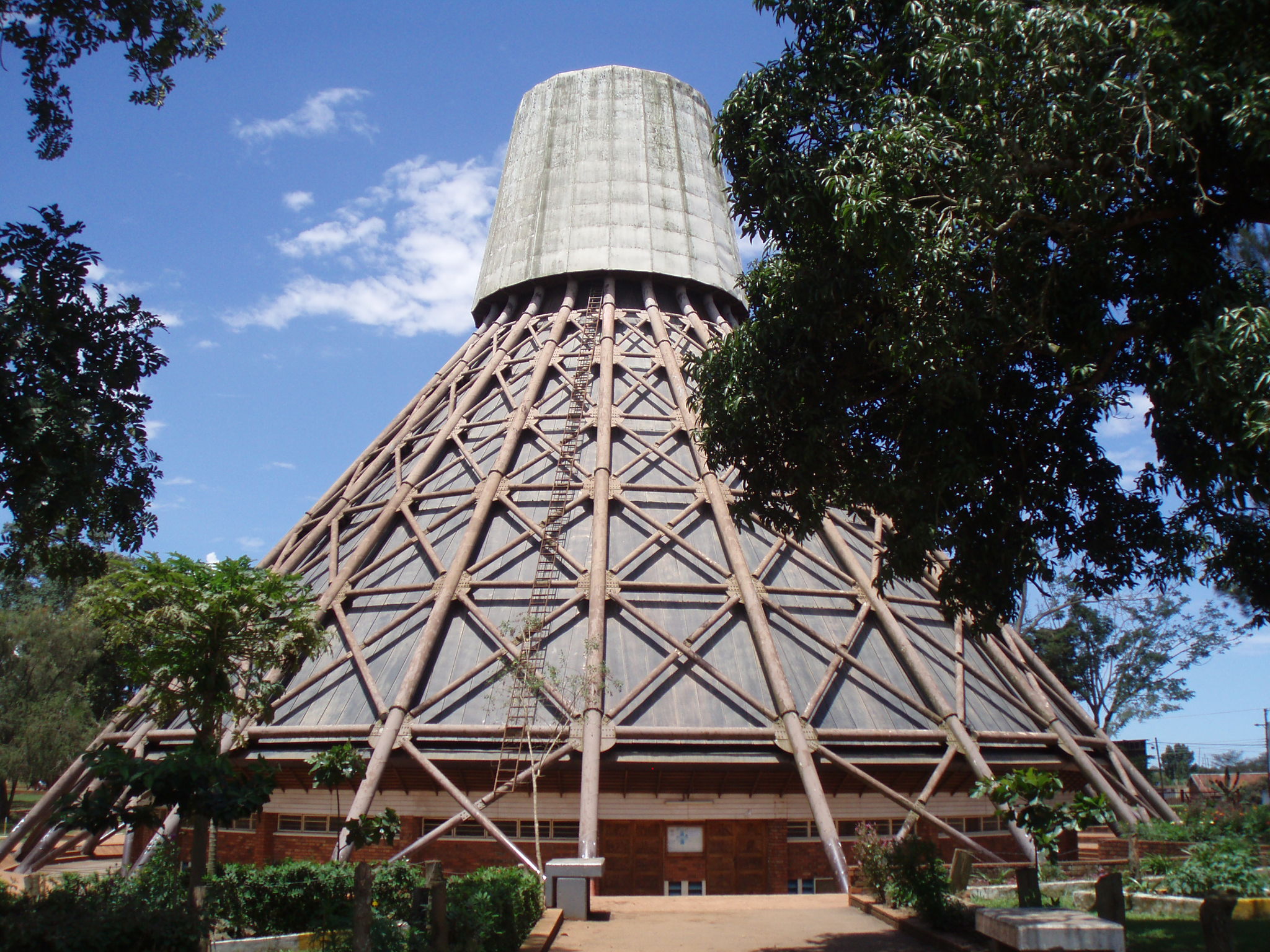
On 3 June 1886, at midday, a young man named Charles Lwanga was wrapped in a reed mat, laid on a funeral pyre at Namugongo, and burned alive. He was the chief of the royal pages in the court of Kabaka Mwanga II of Buganda, and he had refused the king's sexual demands and refused to renounce his Christian faith. Around him, twelve other Catholic converts and thirteen Anglicans perished in the same pyre, killed on the orders of a twenty-year-old king who saw the new religion as a threat to his authority. The smoke rose over the rolling hills of central Buganda. No one present could have imagined that within eighty years this execution ground would become the site of Africa's largest annual pilgrimage, or that Charles Lwanga and his companions would be proclaimed the first black saints of sub-Saharan Africa.
Namugongo lies in Kira Municipality, Wakiso District, some 15 km north-east of central Kampala. Today two shrines stand here, almost side by side: the Catholic Basilica of the Uganda Martyrs, a minor basilica whose altar rests on the very spot of Charles Lwanga's pyre, and the Anglican Namugongo Martyrs' Site, administered by the Church of Uganda to commemorate the twenty-three Anglican converts who died in the same persecution. Each 3 June, Uganda Martyrs' Day — a national public holiday — draws hundreds of thousands, by some estimates over a million, pilgrims who walk for days from across Uganda and beyond to reach this ground.
📜 History & Spiritual Significance
The seeds of the Uganda martyrdoms were sown in the 1870s, when Anglican and then Catholic missionaries arrived at the court of the Kabaka of Buganda, the powerful kingdom centred on the northern shore of Lake Victoria. The young pages of the royal household proved remarkably receptive to Christian teaching, and a growing community of converts emerged within the palace itself — a three-way struggle for influence among Catholic, Anglican, and Muslim factions unfolding against the backdrop of the European Scramble for Africa.
When the young Kabaka Mwanga II ascended the throne in 1884, he grew alarmed at the loyalty his pages showed to their new faith rather than to him. The crisis came to a head over chastity: the Christian pages, taught to refuse the king's sexual advances, would not submit. On 15 November 1885, Mwanga ordered the beheading of Joseph Mukasa, the major-domo of the royal household and the protomartyr of Bantu Africa, who had protested the killing of the Anglican Bishop James Hannington. Further killings followed. On 25 May 1886, Denis Sebuggwawo was killed for instructing the king's favourite boy in the faith.
The defining mass execution came on 3 June 1886 at Namugongo. Charles Lwanga (Kaloli Lwanga, c. 1860–1886), who had become chief of the royal pages and major-domo after Mukasa's death, was wrapped in reeds and burnt slowly from the feet to the head. Twelve other Catholic converts and thirteen Anglicans died with him in the same pyre. In all, between 31 January 1885 and 27 January 1887, Mwanga II ordered the deaths of 22 Catholic martyrs and 23 Anglican converts — a commonly cited total of 45 Christian martyrs.
The 22 Catholic martyrs were declared Venerable by Pope Pius X on 14 August 1912, beatified by Pope Benedict XV on 6 June 1920, and canonised by Pope Paul VI on 18 October 1964 at St. Peter's Basilica in Rome — the first saints proclaimed by Paul VI, the first black saints from sub-Saharan Africa, and at the time the largest group canonised on a single day. The ceremony coincided with the closing period of the Second Vatican Council.
Uganda holds the distinction of being the only sub-Saharan African country to host three reigning popes. Pope Paul VI visited from 31 July to 2 August 1969 — the first pope ever to leave Italy on a pastoral journey — and laid the foundation stone of the new Namugongo Shrine. Pope John Paul II made a pilgrimage to the shrine in February 1993 and, on 7 February, declared it a Minor Basilica. Pope Francis celebrated Holy Mass for the Martyrs at the Catholic shrine on 28 November 2015 and also visited the Anglican martyrs' site, marking the fiftieth anniversary of the canonisation.
☩ Pilgrimage Sites in Namugongo
Basilica of the Uganda Martyrs, Namugongo
Uganda Martyrs Catholic Shrine — Basilica ya Abajulizi ba Uganda, Namugongo
The present shrine was the dream of Emmanuel Cardinal Nsubuga, then Archbishop of Kampala, who raised funds across the United States, Germany, Switzerland, and Rome — famously carrying a raffia bag (ekikapu) to collect contributions. The design was developed by the Swiss architect Dr. Justus Dahinden, and construction was undertaken by ROKO Construction beginning in 1967. The foundation stone was laid by Pope Paul VI during his 1969 visit, and the shrine was officially opened on 3 June 1975 by Cardinal Sergio Pignedoli.
The basilica is a circular church of 42-metre diameter, inspired by the form of a traditional African hut — described as the first of its kind in Africa. Twenty-two seamless steel pillars, each representing one of the 22 canonised Catholic martyrs, rise to support a nine-metre dome of steel and stained glass. The seating of about 1,000 is arranged in a circle around the central altar.
That altar is the heart of the shrine. It stands on the exact spot where St. Charles Lwanga was burnt alive on 3 June 1886. A mahogany altar of Italian design, it shelters beneath it a red light symbolising martyrdom and a glass reliquary holding a first-class relic — a bone — of St. Charles Lwanga.
Behind the basilica lies the Martyrs' Lake, a man-made body of water fed by springs where the executioners, under the chief executioner Mukajjanga, washed their blood-stained spears and tools after the killings. Pilgrims regard the water as carrying the intercession of the martyrs; many fill jerrycans to take home to sick relatives or pour the water over their heads in prayer. At the centre of the lake stands an altar-pavilion where Pope John Paul II celebrated Mass in 1993 and which Pope Francis visited in 2015.
Anglican Namugongo Martyrs' Site
Ekifo ky'Abajulizi ba Uganda ab'Engereza, Namugongo
A separate and distinct shrine administered by the Church of Uganda (Anglican), this site commemorates the 23 Anglican converts killed on 3 June 1886 for refusing to recant their faith. It stands approximately 2.1 km north-east of the Catholic basilica, both within Kira Municipality — a visible ecumenical testimony, the two shrines standing side by side.
The Anglican site features martyrs' sculptures depicting the Ugandan Christian martyrs, a Martyrs' Museum with lifelike reconstructions of the martyrs in reed huts, a main pavilion, and perimeter walkways upgraded ahead of Martyrs' Day. The Uganda Martyrs' Seminary (UMS) of Namirembe Diocese shares the premises, founded on the martyrdom site in memory of the martyrs and to mark the centenary of the Anglican Church in Uganda in 1977. The Anglican martyrs are not canonised by Rome; the site commemorates its own 23 martyrs separately, and Anglican services run side-by-side with the Catholic Mass on 3 June.
🕯️ Annual Feast Days & Celebrations
Uganda Martyrs' Day — June 3
Uganda Martyrs' Day, held annually on 3 June, commemorates the mass execution of 3 June 1886. It is a national public holiday and one of the largest annual religious gatherings on the African continent. The main Catholic Mass is celebrated at the basilica, led each year by a different diocese of Uganda on a rotating basis, while Anglican services take place at the neighbouring shrine.
The scale of the pilgrimage is extraordinary. Government figures recorded approximately 690,000 pilgrims at the two shrines in 2024, with broader activity estimates of 2.5 to 3 million people across the pilgrimage period; in 2025, over 813,000 visitors were counted at Namugongo, with one Catholic news outlet reporting a crowd of possibly more than four million. Pilgrims walk for days from across Uganda, Rwanda, Kenya, Tanzania, and beyond, many arriving barefoot and camping on the shrine grounds in the days before the feast. On 3 June the road is closed to general traffic and the faithful walk the final stretch.
🛏️ Where to Stay
Namugongo itself is a suburb of greater Kampala, not a resort town, and has almost no lodging beyond a single pilgrim-oriented inn. The realistic base for most pilgrims is central Kampala, approximately 11 km away, which offers a full range of hotels.
Egret Pilgrims Inn (guesthouse) — The one pilgrim-oriented lodging at the shrine, on Naalya–Namugongo Road approximately 500 m from the basilica, with garden-facing rooms, a restaurant, bar, free parking, and airport shuttle. Website
Kampala Serena Hotel ⭐⭐⭐⭐⭐ — A five-star hotel set in 17 acres of gardens near the Central Business District and diplomatic missions, with 186 rooms and suites. Website
Speke Hotel (hotel) — A historic central Kampala hotel established in the 1920s, with 50 en-suite rooms, approximately 30 minutes' drive from Entebbe International Airport. Website
Mt. Zion Hotel (guesthouse) — A central Kampala hotel in the business district with a restaurant and taxi services. Website
More hotels in Namugongo on Booking.com →
Accommodation available to book near Namugongo. Pilgrim houses and religious guesthouses are listed above — many take bookings directly and do not appear on booking sites.
🚗 Getting There
By Air: The nearest international airport is Entebbe International Airport (EBB), Uganda's only international airport, on the northern shore of Lake Victoria approximately 40–45 km south-west of central Kampala (a 45–60 minute drive via the Entebbe–Kampala Expressway). The great-circle distance from Entebbe to Namugongo is approximately 45 km.
By Road: Namugongo sits in Kira Municipality, north-east of central Kampala. The great-circle distance from central Kampala to the shrine is approximately 11 km; by road the route is 13–15 km, a 20–40 minute drive depending on traffic.
Local Transport: Special-hire taxis (private hire cars) are the standard comfortable option. Matatus — 14-seater paratransit minibuses — run dedicated routes to the Uganda Martyrs National Shrine stop from Kampala's Old Taxi Park, Nakawa Taxi Park, and City Square, and are the everyday way pilgrims reach the shrine. Boda-boda motorcycle taxis are fast through traffic and commonly used for the last mile; helmets are advised and the fare should be agreed in advance.
On Foot: During the Uganda Martyrs' Day pilgrimage on 3 June, the road is closed to general traffic and pilgrims walk the final stretch. Hundreds of thousands arrive on foot, many having walked for days from across the country, so normal transport times do not apply on that day.
📚 Further Reading
Books:
J. F. Faupel. African Holocaust: The Story of the Uganda Martyrs — The classic scholarly history of the 1885–87 martyrdoms under Kabaka Mwanga II, first published in 1962 (St. Paul Publications Africa edition, 245 pp). Still the standard English-language account.
Mandy Margaret Bjordal. Dying for a Heavenly King: The Baganda Catholic Martyrs — A narrative retelling of the 22 Catholic martyrs set against the Buganda court and the three-way religious struggle (CreateSpace, 2020, 237 pp).
🎥 Recommended Videos
Francis in Uganda: Holy Mass in Namugongo (28 Nov 2015) — Pope Francis's open-air Mass at the Namugongo shrine, the most authoritative visual record of the site as a place of living pilgrimage. Vatican News, 2 h 14 min.
Highlights of Uganda's Martyrs' Day 2024 — EWTN's summary of the annual 3 June pilgrimage, showing the scale and character of Martyrs' Day today. 8 min 45 sec.
Pilgrimage to Uganda Martyrs Catholic Shrine Basilica, Namugongo — A short walk-through of the basilica and shrine grounds from a Catholic (Capuchin) channel. Capuchin Tv, 3 min 20 sec.
🔗 Useful Links
Uganda Martyrs Catholic Shrine, Namugongo — official site — The basilica's own website, with pages on the basilica's architecture, the martyrs' history, and the parish.
Kampala Archdiocese — Who are the Uganda Martyrs? — The owning archdiocese's overview of the martyrs, with individual saint pages.
Vatican — Pope Francis's homily at Namugongo (28 Nov 2015) — The official Vatican page for the 2015 papal Mass at the shrine.
GCatholic — Basilica of the Uganda Martyrs, Namugongo — Reference entry listing the minor basilica decree and papal visits.
🧭 Nearby Pilgrimage Destinations
Kibeho, Rwanda (480 km south-west) — Africa's only Vatican-approved Marian apparition site, where the Virgin Mary appeared to schoolgirls between 1981 and 1989 in the hills of southern Rwanda.
**Munyonyo, Uganda (17 km south of Namugongo) — Another Uganda Martyrs site, associated with St. Andrew Kaggwa, where a chapel and shrine mark an earlier killing in the 1885-87 persecution. No guide yet.
🪶 Closing Reflection
"These African saints… are the first fruits of the evangelization of the African continent."
— Pope Paul VI, Homily at the Canonization of the Uganda Martyrs, 18 October 1964