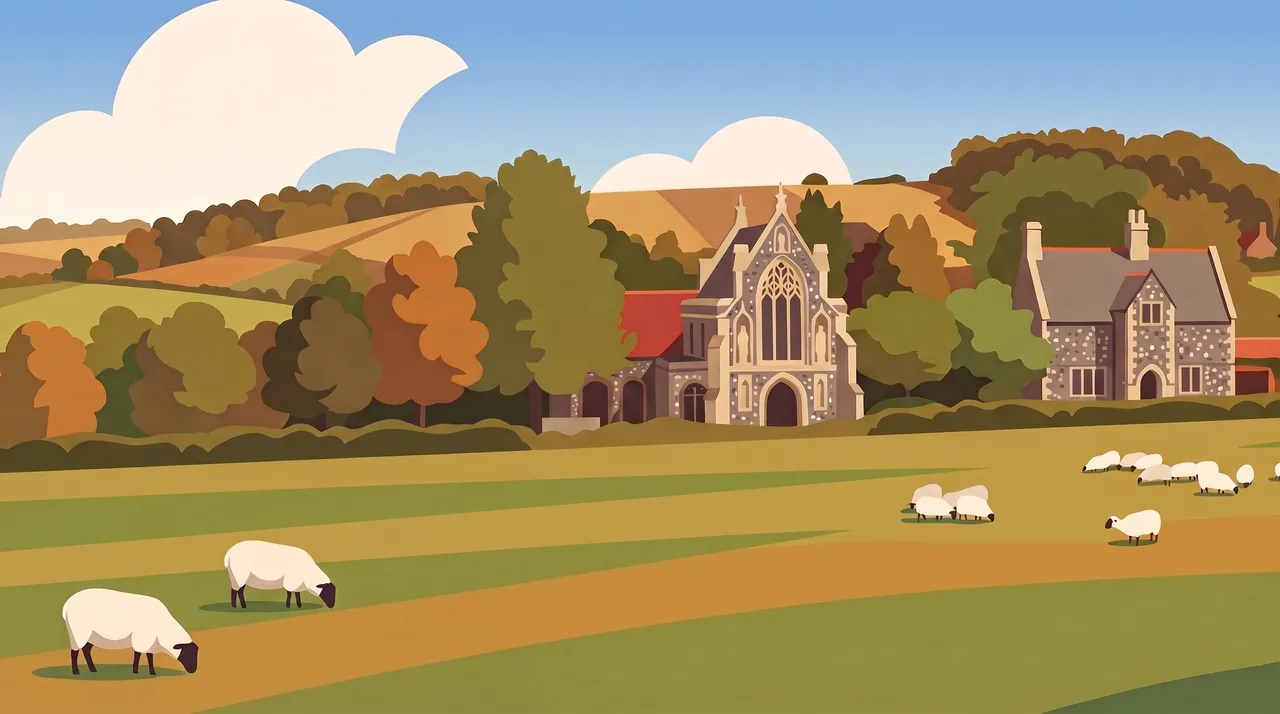
In the year 1061, according to medieval tradition, the Virgin Mary appeared to a Saxon noblewoman named Richeldis de Faverches in this remote Norfolk village. Mary showed Richeldis the house in Nazareth where the Annunciation had occurred and asked her to build a replica in England. The Holy House of Walsingham became "England's Nazareth." Through the Middle Ages it ranked among Christendom's great pilgrimage destinations, rivaling Canterbury, Rome, and Compostela. Kings walked barefoot to the shrine; the sick came seeking healing; and countless ordinary pilgrims made the journey that became known as the "Walsingham Way."
Henry VIII destroyed the shrine in 1538, his commissioners burning the ancient statue of Our Lady and pulling down the priory. Walsingham then lay desolate for generations, its site marked only by the ruined archway of the priory. In 1897, Charlotte Pearson Boyd purchased the fourteenth-century Slipper Chapel—the last wayside chapel where pilgrims had removed their shoes to complete the final mile barefoot—and restored it for Catholic worship. Walsingham was reborn.
Today, two shrines serve two traditions: the Anglican Shrine of Our Lady of Walsingham in the village center, and the Catholic National Shrine at the Slipper Chapel, about a mile away. Both honor the Marian visions that made this quiet corner of Norfolk sacred ground, and both welcome pilgrims seeking the intercession of Our Lady of Walsingham.
📜 History & Spiritual Significance
The original apparition to Richeldis de Faverches in 1061 (some accounts say 1061, others suggest later dates) initiated devotion that would shape medieval English piety. Richeldis, with the help of workmen who found the precise location miraculously indicated, built a wooden house replicating the dimensions of Mary's home in Nazareth. The Holy House became a place of intense Marian devotion.
Augustinian canons arrived in the twelfth century, establishing a priory that would manage the growing pilgrimage. The Holy House was enclosed within a stone chapel; the statue of Our Lady of Walsingham—depicting Mary seated with the Christ child—became one of the most venerated images in England. Indulgences were granted; miracles were recorded; and the path to Walsingham became worn by pilgrims' feet.
The roster of royal pilgrims reads like a chronicle of medieval England: Henry III came repeatedly from about 1226; Edward I more often still; and even Henry VIII made the pilgrimage before his break with Rome—an irony that later generations would note with bitterness when he ordered the shrine's destruction. The statue was taken to London and publicly burned; the priory was dissolved; and the buildings became a quarry for local construction.
The Catholic revival in Walsingham began with the Slipper Chapel's restoration in 1897. Pope Leo XIII blessed a new statue of Our Lady of Walsingham for the chapel; pilgrimages resumed. In 1934, the Slipper Chapel became the Catholic National Shrine of Our Lady, and annual pilgrimages have grown steadily since.
The Anglican shrine, established in 1931, represents a parallel revival within the Church of England. Its Holy House reproduces the medieval original, and its devotional life draws on Catholic traditions within Anglicanism. The two shrines coexist in creative tension, both honoring Mary, both claiming inheritance from the medieval tradition.
☩ Pilgrimage Sites in Walsingham
Catholic National Shrine and Slipper Chapel
The Slipper Chapel
The fourteenth-century Slipper Chapel, restored by Charlotte Boyd and her successors, serves as the Catholic National Shrine of Our Lady. The small medieval chapel houses the replica statue of Our Lady of Walsingham—a copy of the medieval original, enthroned as the focus of devotion.
The surrounding complex includes the Chapel of Reconciliation (consecrated 1982), outdoor altars for large pilgrimages, a pilgrim center, and grounds for prayer and reflection. The Holy Mile—the traditional pilgrimage path from the Slipper Chapel to the site of the medieval shrine—can still be walked.
Priory Ruins and Medieval Site
The ruins of the Augustinian Priory mark the site of the medieval shrine. The great east window arch and scattered foundations evoke the grandeur of the pre-Reformation pilgrimage. The grounds are open to visitors, the entrance at the Shirehall Museum on Common Place. The medieval Holy House stood within these walls.
Anglican Shrine of Our Lady of Walsingham
While not Catholic, the Anglican shrine is historically significant and ecumenically important. Its Holy House, built in 1931, reproduces the dimensions of the medieval original. The shrine church houses a statue of Our Lady of Walsingham based on medieval seals. Many Catholic pilgrims visit for historical interest.
Church of the Annunciation (Catholic Parish Church)
The Catholic parish church in Walsingham village, dedicated to the Annunciation, serves local Catholics and pilgrims. Its presence witnesses to the continuity of Catholic life in this sacred place.
🕯️ Annual Feast Days & Celebrations
Feast of Our Lady of Walsingham — September 24
The principal feast day brings thousands of pilgrims to the Slipper Chapel for outdoor Mass, processions, and Marian devotions.
Dowry of Mary Pilgrimage — Sunday nearest September 8
The Catholic National Shrine's own annual pilgrimage, held on the Sunday nearest the Nativity of Mary (September 6 in 2026). The afternoon procession goes from the shrine at the Slipper Chapel along the Holy Mile to the priory grounds in the village, where the day closes with Benediction.
National Pilgrimage (Anglican Shrine) — Spring Bank Holiday Monday, Late May
The Anglican Shrine's great day, not a Catholic event: Sung Mass in the morning, then a procession of the image of Our Lady through the village and Benediction. Catholic pilgrims are welcome to watch, and the village is at its busiest.
Student Cross Pilgrimage — Easter Week
University students walk to Walsingham during Holy Week, converging from starting points across Britain.
Assumption of Mary — August 15
Summer pilgrimage with Masses and devotions at the National Shrine.
Rededication of England as the Dowry of Mary — March 29, 2020
Not an annual feast: on this day in 2020 the bishops of England rededicated the country to Our Lady under her ancient title, in a ceremony centred on the shrine. The anniversary is kept quietly; the Dowry of Mary Pilgrimage in September is its living expression.
🛏️ Where to Stay
Elmham House (pilgrim accommodation) — The Catholic National Shrine's own pilgrim hotel, on Friday Market Place in the heart of the village, with rooms for more than 100 guests and its own restaurant and bar. Website ∙ Reserve
The Bull Inn (guesthouse) — A traditional pub with a handful of letting rooms on the Common Place, 2.1 km from the Slipper Chapel. Website ∙ Reserve this hotel
Black Lion Hotel (guesthouse) — A Grade II listed pub with six ensuite bedrooms on the Friday Market Place, 1.9 km from the Slipper Chapel. Website ∙ Reserve this hotel
Walsingham Bakehouse (guesthouse) — A guest house in a historic building in the village, 2.0 km from the Slipper Chapel. Reserve this hotel
More hotels in Walsingham on Booking.com →
Accommodation available to book near Walsingham. Pilgrim houses and religious guesthouses are listed above — many take bookings directly and do not appear on booking sites.
🚗 Getting There
By Air: Norwich Airport (NWI) is approximately 45 km southeast, with limited connections. London Stansted (STN) is approximately 150 km south.
By Train: The nearest railway station is King's Lynn, 40 km (25 miles) away, about 35 minutes by road, with connections from London King's Cross via Cambridge. From King's Lynn, take a bus or taxi to Walsingham.
By Bus: Coasthopper buses connect Walsingham to Wells-next-the-Sea, King's Lynn, and the Norfolk coast. Services are limited; check timetables.
By Car: From London, take the A11 north toward Norwich, then A1067 and B1105 to Walsingham (approximately 200 km, 3 hours). Parking is available at the Slipper Chapel and in the village.
On Foot: Traditional pilgrimage routes approach Walsingham from London, King's Lynn, and Ely. The Holy Mile from the Slipper Chapel to the village remains the essential pilgrimage walk.
📚 Further Reading
Michael Walsh. Walsingham: Pilgrimage and History — Historical study of the medieval and modern shrine.
H.M. Gillett. Walsingham: The History of a Famous Shrine — Classic account of the shrine's development.
Elizabeth Ruth Obbard. A Journey to Walsingham — Spiritual guide for pilgrims.
Fr. Henry Sebastian Bowden. Mementoes of the English Martyrs and Confessors: For Every Day in the Year — A martyr or confessor for every day of the year, each entry a short account of their death or an extract from their own writing.
Online Resources:
Catholic National Shrine — Official Catholic shrine website with pilgrimage information.
Catholic Encyclopedia: Walsingham Priory — Historical overview.
🎥 Recommended Videos
The Mystery of Walsingham — Part 1: Our Lady's Holy House Foundation — The apparition to Richeldis and the rise of the medieval shrine. EWTN Great Britain, 28 minutes.
The Mystery of Walsingham — Part 2: Our Lady's Holy House Destruction — The Reformation, the burning of the statue and the long silence that followed. EWTN Great Britain, 26 minutes.
In Search of Walsingham: Mary, Pilgrimage and Icons — A pilgrim's account of the two shrines and the devotion they keep. 24 minutes.
Hundreds Walk 50 Miles to Walsingham on Traditional Catholic Pilgrimage — A report from the annual walking pilgrimage that arrives for the feast. EWTN Great Britain, 3 minutes.
🔗 Useful Links
Catholic National Shrine — Mass times, events, and pilgrimage booking.
Diocese of East Anglia — Diocesan resources.
Walsingham Village — Local tourism information.
🥾 Pilgrim Routes
The Holy Mile — The last mile, from the Slipper Chapel at Houghton St Giles into the village, walked barefoot by tradition. Every route below ends on it.
From Norwich — the Walsingham Way — 58–60 km / 36–37 miles, three days. The best waymarked of the Norfolk routes: from Norwich Cathedral and the cell of Julian of Norwich, up the Wensum valley, across the plateau by the Snoring villages and down into the valley of the Stiffkey. It counts as 59 km toward a Camino Inglés compostela.
From King's Lynn — 47 km / 29 miles, two to three days. Launched in June 2026, from King's Lynn Minster by Castle Rising, Sandringham and Great Bircham to South Creake and North Barsham. Medieval pilgrims from the north crossed the Wash and came in this way.
From Ely — 117 km / 73 miles, seven days. Out of Ely Cathedral onto the fen, following drainage channels and the Little Ouse to Weeting, where the route from Bury St Edmunds joins, then north by the old Peddars Way and Swaffham to the ruins of Castle Acre Priory, a medieval staging post. The Latin Mass Society walks a more direct mid-Norfolk line each August, about 90 km / 56 miles in two and a half days.
From Cley-next-the-Sea — 26 km / 16 miles, one day. Cley and neighbouring Blakeney were the landing places for pilgrims who came by sea. From St Margaret's across saltmarsh and common, then inland by Binham Priory. From Morston it is 18 km / 11 miles.
From Bromholm Priory — 66 km / 41 miles, three days. Bromholm at Bacton held a relic of the True Cross and drew pilgrims in its own right; many visited both houses. The revived path follows the north coast past Beeston and Weybourne and turns inland at Binham.
From Great Yarmouth — 98 km / 61 miles, six days. Another medieval pilgrim port. The route follows the rivers of the Broads to St Benet's Abbey standing in the reeds, then the Bure valley and an old railway path. It is the longest walk that stays within Norfolk.
From London — the London to Walsingham Camino — 286 km / 178 miles in thirteen stages. The main road of medieval English pilgrimage, revived as a waymarked route: from St Magnus the Martyr by London Bridge, which keeps its own shrine of Our Lady of Walsingham, by Waltham Abbey, Bury St Edmunds, Thetford and Castle Acre.
🧭 Nearby Pilgrimage Destinations
Canterbury (250 km) — Cathedral and shrine of St. Thomas Becket.
London (180 km) — Westminster Cathedral, Tyburn Convent, and numerous Catholic sites.
Aylesford (200 km) — Carmelite priory and shrine of St. Simon Stock.
Norwich (45 km) — Cathedral and Catholic churches.
Ely (70 km) — Cathedral and shrine of St. Etheldreda.
🪶 Closing Reflection
"In England, 'the Dowry of Mary', the faithful, for centuries, have made pilgrimage to her shrine at Walsingham."
— Pope John Paul II, Homily at Wembley Stadium, May 29, 1982


